2013-06-09: Updated from my visit on Saturday, 6/8.
The Sale
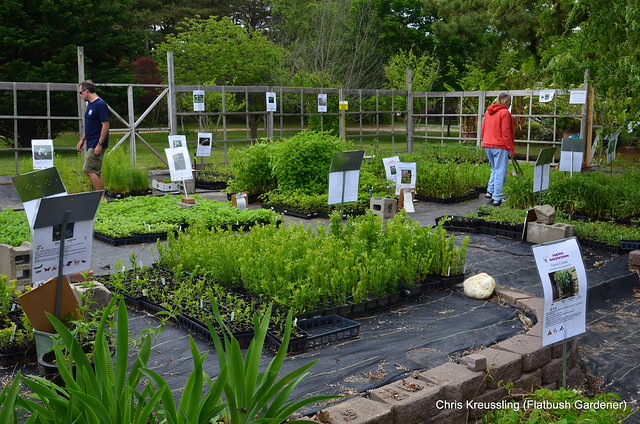
This Friday and Saturday, June 7 and 8, and next week as well, June 14 and 15, is a rare opportunity to purchase local ecotypes – plants propagated from local wild populations – of plants native to Long Island. The sale is organized by the Long Island Native Plant Initiative (LINPI). Proceeds benefit LINPI.
It’s gratifying to see this happening. I’ve lived most of my life on Long Island, including the 20+ years I’ve lived in Brooklyn which, after all, comprises the westernmost reaches of Long Island.
Note that the location of the sale is not at LINPI’s headquarters. The sale is at the Greenhouse of the Eastern Campus of Suffolk County Community College, 121 Speonk-Riverhead Road, Riverhead NY 11901.
The Plants
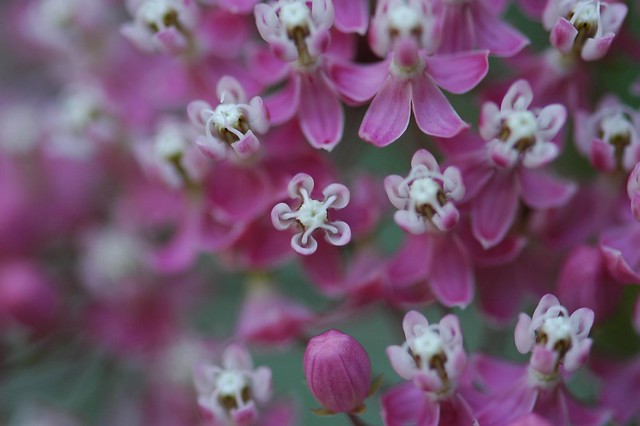
Asclepias incarnata, Swamp Milkweed, one of the species on sale.
These are species that were advertised to be in the sale. There were even more species available that were not listed in advance, nearly double this number available onsite, a diverse selection.
| Botanical name |
Common Name |
| Myrica pensylvanica |
Northern Bayberry |
| Pinus rigida |
Pitch Pine |
| Prunus serotinus |
Black Cherry |
| Andropogon gerardii |
Big Bluestem |
| Andropogon virginicus |
Broome Sedge |
| Dichanthelium clandestinum |
Deer Tongue |
| Eragrostis spectabilis |
Purple Lovegrass |
| Panicum virgatum |
Switchgrass |
| Schizachyrium scoparium |
Little Bluestem |
| Sorghastrum nutans |
Indian Grass |
| Tridens flavus |
Purple Top/Grease Grass |
| Asclepias syriaca |
Common Milk Weed |
| Asclepias tuberosa |
Butterfly Weed |
| Asclepias incarnata |
Swamp Milkweed |
| Baptisia tinctoria |
False Indigo |
| Chrysopsis mariana |
Maryland Goldenaster |
| Eupatorium fistulosum |
Joe Pye weed |
| Eupatorium hyssopifolium |
Hyssop-leaved Thoroughwort |
| Eupatorium serotinum |
Late-flowering Thoroughwort |
| Euthamia caroliniana |
Slender Goldentop |
| Euthamia gramnifolia |
Grass-leaved Goldentop |
| Lespedeza capitata |
Round-headed Bush Clover |
| Lespedeza hirta |
Hairy Bush Clover |
| Lespedeza virginica |
Slender Bush Clover |
| Opuntia humifusa |
Eastern Prickly Pear |
| Pseudognaphalium obtusifolium |
Sweet Everlasting |
| Pycnanthemum tenuifolium |
Slender-leaved Mountain Mint |
| Pycnanthemum virginianum |
Virginia Mountain Mint |
| Rudbeckia hirta |
Black Eyed Susan |
| Solidago nemoralis |
Gray Goldenrod |
| Solidago juncea |
Early Goldenrod |
| Symphyotrichum laeve |
Smooth Blue Aster |
| Symphyotrichum novae-angliae |
New England Aster |
| Symphyotrichum pilosum |
Hairy White Field Aster |
| Vernonia noveboracensis |
New York Ironweed |
My Selections
I picked up over a dozen different species, most of them second year seedlings in six-packs.
- Asclepias incarnata, Swamp Milkweed
- Asclepias tuberosa, Butterfly Weed
- Baptisia tinctoria, Wild Indigo
- Eragrostic spectabilis, Purple Lovegrass
- Ionactis linarifolius, Stiff Aster
- Lespedeza capitata, Roundhead Lespedeza
- Opuntia humifusa, Eastern Prickly-Pear
- Pycnanthemum tenuifolium, Narrow-Leaved Mountain-Mint
- Pycnanthemum virginianum, Virginia Mountain-Mint
- Schizachyrium scoparium, Little Bluestem
- Trichostema dichotomum, Forked Blue Curls
- Verbena hastata, Blue Vervain
- Viola lanceolata, Bog White Violet
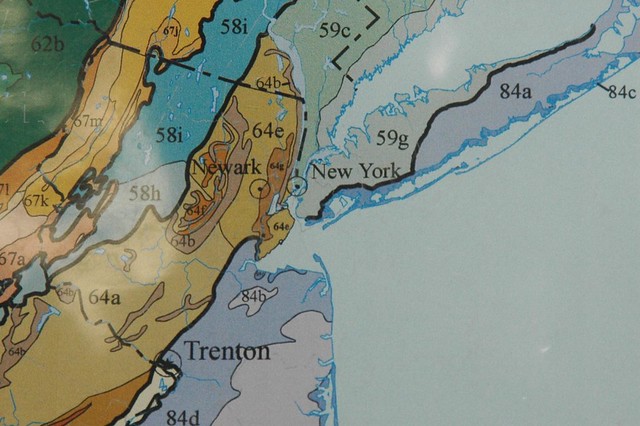
Map of Level IV Ecoregions in and around New York City, including most of Long Island.
Related Content
Flickr Photo Set
Native Plants
Links
Long Island Native Plant Initiative (LINPI): Plant Sale
Native Plant Sale, June 7,8; June 14, 15, 2013 (Facebook Event Page)
Google Map
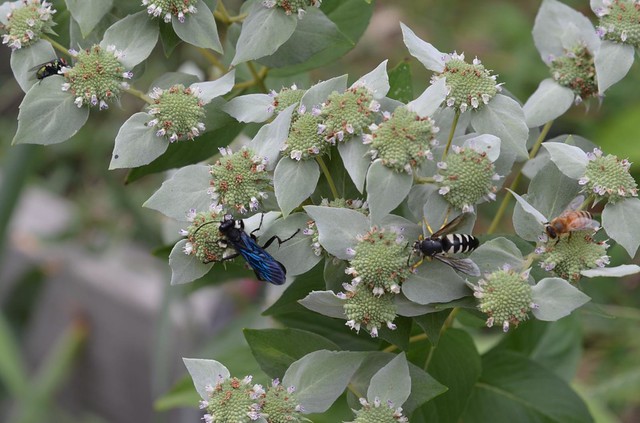
Pycnanthemum muticum, Clustered Mountain-Mint in my garden, bejeweled with pollinators. Two other species are on sale.