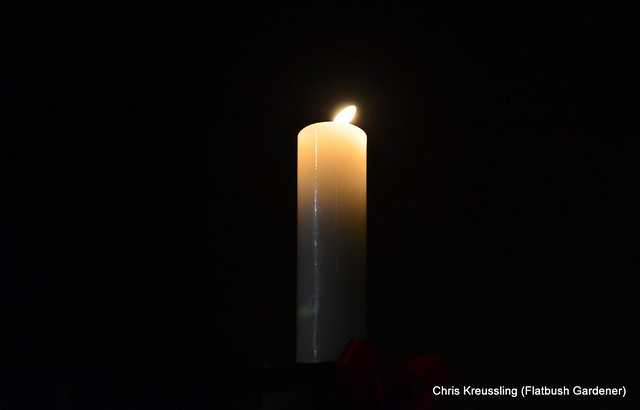
Standing Still 2021: Demeter Waiting

Today is the December solstice: the winter solstice in my hometown Northern hemisphere, summer in the Southern.

Persephone and her Pomegranate

Dante Gabriel Rossetti, 'Proserpine', 1874

The millenia-old story of Persephone and her pomegranate, in all their incarnations, strikes me as a deeper analogy this Winter. Persephone was abducted, held hostage in hell, and starved. Only under this extreme duress did she eat anything she was offered: a few seeds of the pomegranate to stave her hunger.

I can relate to “being held hostage in hell”. I feel as though I’ve endured six years of it. I know others do, as well.

While our personal histories may provide us with tools and resources to endure, so much of our resiliency is shaped by systemic forces. Conservative forces of this country have worked for decades, all my adult life, to destroy all social supports – health care, housing, education, food, transportation – that should be our common responsibility, “privatizing” them into for-profit enterprises available only to those who can afford it, and parasitizing what should have been our collective wealth into the hands of fewer and fewer.

The past six years has broken people.

Endurance trauma takes unique forms in all of us. We can become numb. We can become paralyzed by fear. We might take risks we would not have accepted before. We may lash out, seeking targets for our rage. It can lead us to embrace the dark places. I have lost friends and colleagues to those places throughout all this, especially over the past year.

Maybe I am more like Demeter, weeping for the hold darkness has over others, while reaching and hoping for a time when we can bring everyone back into the light.

A Single Candle

Related Content

All my past Winter Solstice posts: 

  • 2018: Standing Still in 2018
  • 2016: Standing Still 2016
  • 2015: Standing Still
  • 2014: The Sun stands still
  • 2010: From Dark to Dark: Eclipse-Solstice Astro Combo
  • 2009: Standing Still, Looking Ahead
  • 2008: Stand Still / Dona Nobis Pacem
  • 2007: Solstice (the sun stands still)

Links

Wikipedia:

Garden Design Pattern Languages

Adapted from a tweet thread.

In a guest post on the ASLA’s “Dirt” column, Alden E. Stone, CEO of Nature Sacred, writes:

[Our new report] is part research and part practical guide, and shares key insights gained through having co-created more than 100 Sacred Places across the country in communities, many under-resourced; in prisons, at universities, and in hospitals. A handful of these sites were also implemented as part of an expansive, decade-long design, build, and research project. …

For the research portion of this paper, we focused our attention on four domains: nature’s impact on individual, community, economic and ecological health. …

for many of the individual and community health benefits to kick in, people must engage with nature. Spend time in the green space. And this is where Nature Sacred has spent a lot of energy over the past two decades — looking at how to best engage the community and how to best design so that the community embraces, and spends time in, their green space.

She describes four “design elements”:

  • Portal
  • Path
  • Destination
  • Surround

These design patterns recur in many different types of gardens, whether intentionally healing/sacred or not.

My backyard embodies all four elements. What follows is an exploration of the history of my backyard, from inception to its current state, viewed through the frame of those four design elements.
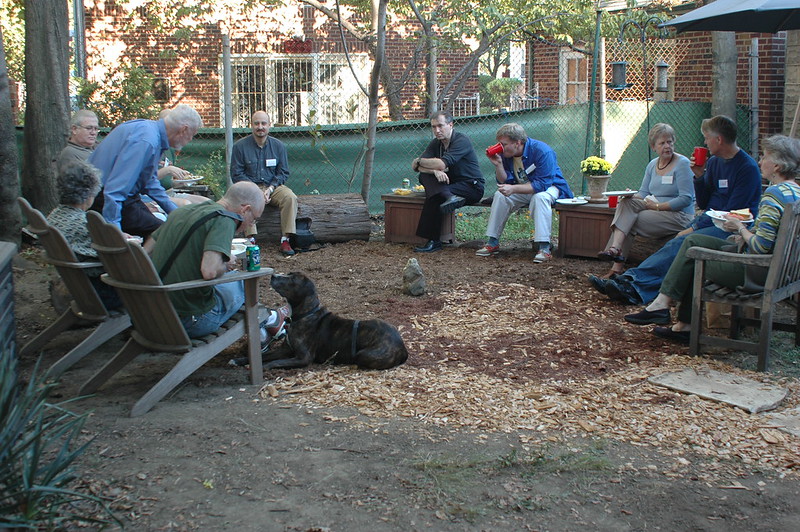
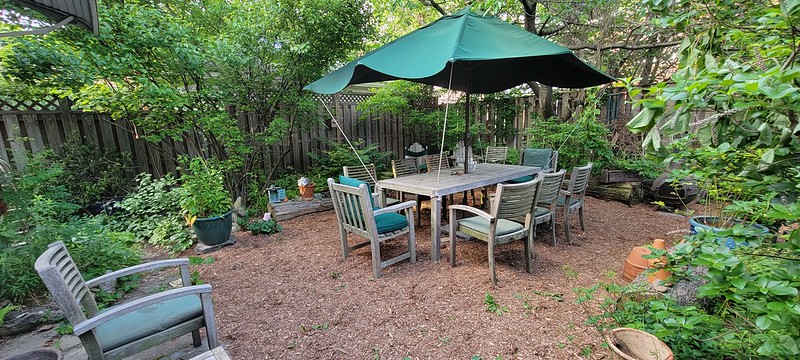
The Backyard, House Opening Party, October 2005 The Backyard, ready for visitors, June 2021

2005

My first sketch of the backyard, just after we bought our house. You can see portals/transitions, paths, seating as destinations, and the surround of enveloping plants. (Even though we had just moved in, I was also fantasizing about changing out the whole back of the house and adding a rear porch to better connect it with the backyard. That never happened.)

Backyard Garden Design Sketch, 2005-06-22

2006

By our second Spring, I better understood how light and shade shifts over the garden throughout the year. The plan is refined and made more specific, less conceptual. The Gardener’s Nook is now defined. The driveway-backyard portal shows up: the garage and house both connected and separated by a fence and trellis through which one would pass to enter the backyard from the driveway.

Backyard Garden Design Sketch, 2006-04-30

Using the sketch as a guide, the loose circle shown in the opening photo gets tightened up, better defined. Bringing the sketch to life, the desination Gardener’s Nook – the upper left of the sketch directly above – makes it first appearance with a pair of Adirondack chairs and some decor. Plants in containers begin to define the surround. An umbrella substitutes for the missing tree canopy.
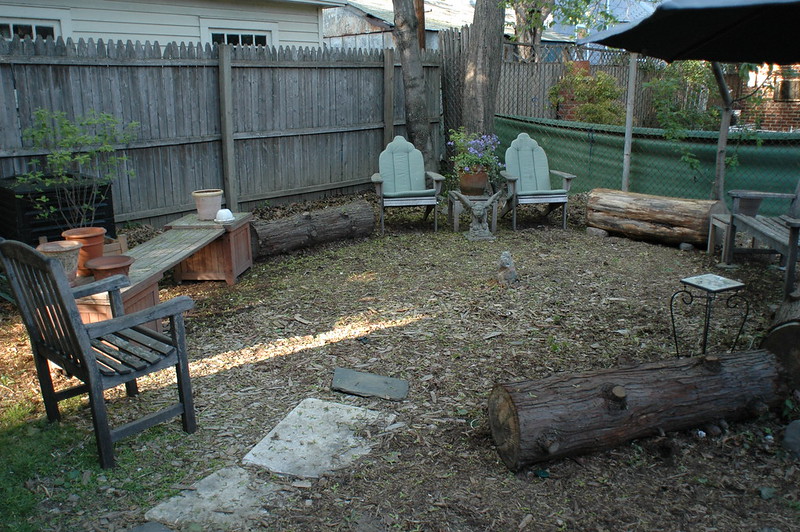
The Backyard, May 2006

2007

A year after that, things are really coming together. A trellis establishes the portal entrance from the driveway into the backyard. This filters the line of sight into the backyard, which beckons one to venture through, and past.

Filtered View into the Backyard from the Driveway, July 2007

The center of the circle gets filled in. A table both provides central desination, and defines a circular path around itself, echoing the initial concept sketch. Logs double as seating and a layer of surround. The plants are now getting large enough to provide a second layer. My rear neighbor thankfully provided a fence, closing off the backyard and completing the surround.

The Backyard, July 2007

2009

Winter 2009: My Garden Design class final project is my backyard, striking a balance to maximize planting area – a deep surround – while retaining space for people. Curved borders echo the original spiral.

Final rendering, backyard garden design

Although the built environment of that design is never realized, the plan and its rough dimensions inform all later changes. Later that year, I transplant a large shrub. This gives the backyard a sense of enclosure, the “surround”.

After transplant

2010

I plant an “understory” tree which will provide overhead enclosure, a vertical surround. As I had specified in my garden design, I selected an Amelanchier, which goes by many wonderful phenologically evocative common names. It serves as a replacement for the old apple tree my north-side neighbors had in their backyard, adjacent to our shared fence. Eventually, it brings back the cedar waxwings I enjoyed seeing amongst its flowers.
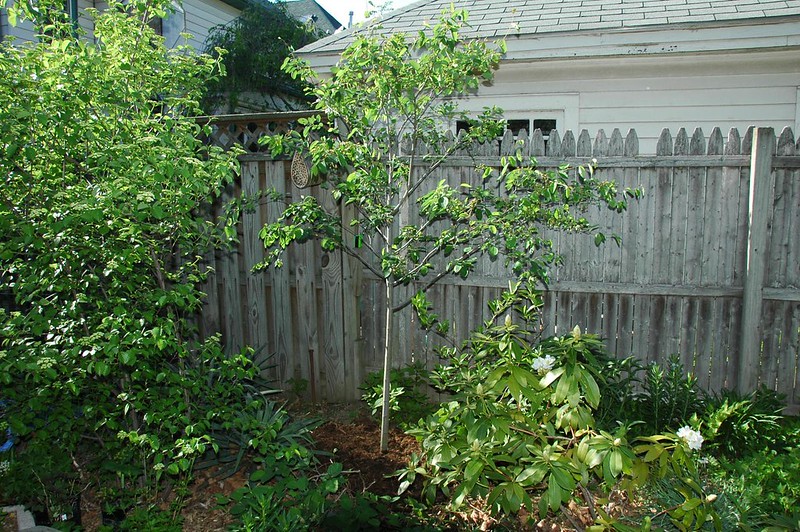
The new serviceberry, planted and mulched, May 2010

2011

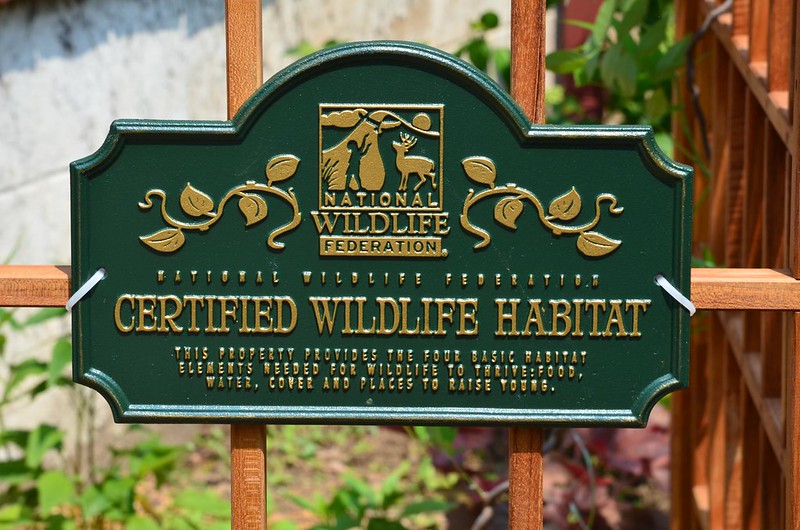
The portal/entrance to the backyard gets a major makeover. I register with the National Wildlife Federation (NWF) as a Backyard Wildlife Habitat. My garden itself becomes a destination, and welcomes its first public visitors.
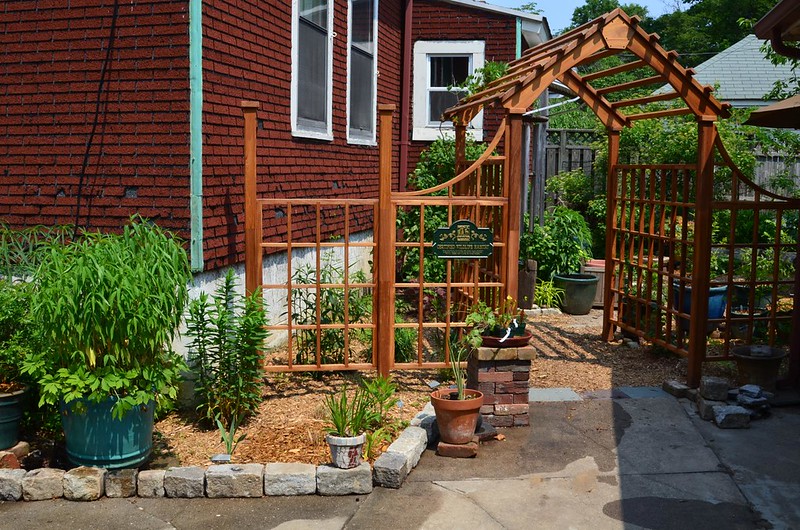
Arbor entrance
Certified Wildlife Habitat sign

2014

The garden hosts a wedding, its first use as an intentionally sacred space.
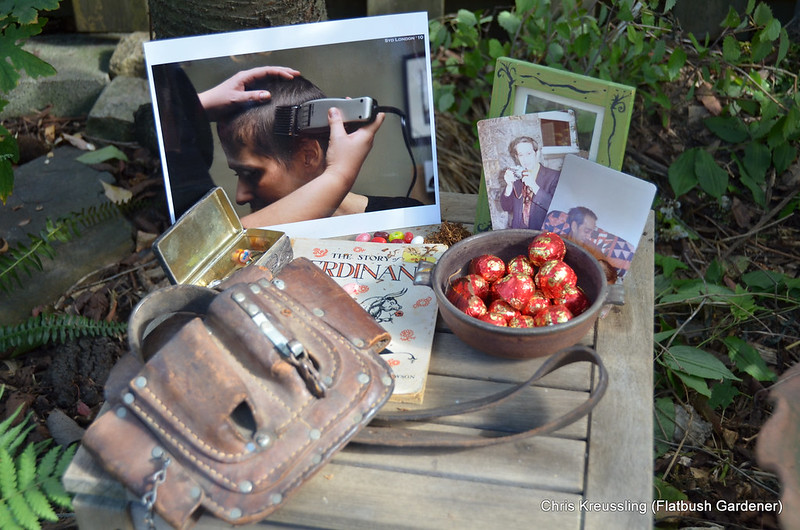
Ancestor's Altar, Jay & Syd's Big Fat Queer Wedding, October 2014

2016

Five years later, the shrubs and other plantings have matured, and the surround of enveloping greenery and flowers has been realized. The Gardener’s Nook is now a fully-sheltered spot, a desination tucked into the larger embrace of the garden.

Morning Glory: My urban backyard native plant garden & wildlife habitat

2018

This garden continues to be a sacred/healing space for many over the years. It was sanctuary for our dear friend David. After he entered home hospice, he would call a car service to deliver him to the garden. Here he is in the Gardener’s Nook two weeks before he died.
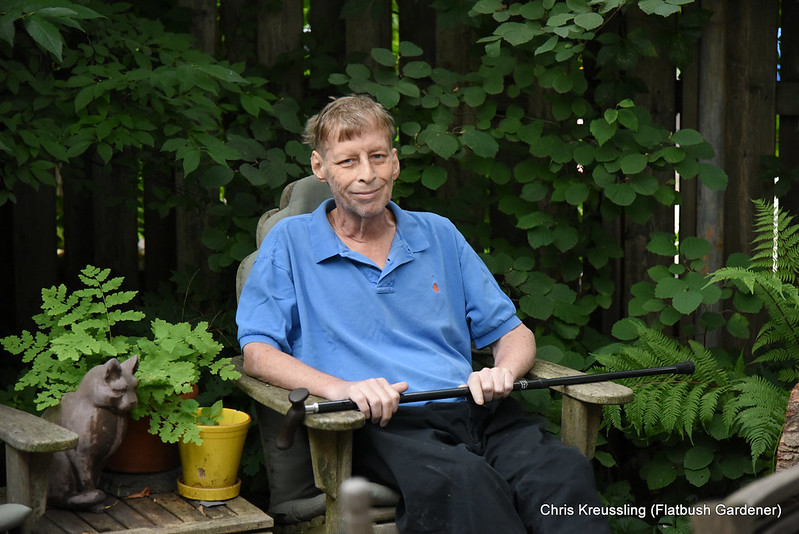
David Charles Ashley, in my backyard, July 2018, 2 weeks before he died

2021

Today, 16 years after that first sketch, the backyard has realized its final form. Visitors say they feel like they’ve walked into the woods, the highest praise.

Portal, path, destination, surround – all embodied, and felt, in the garden.

Entrance through the arbor to the backyard, June 2021

Related Content

Hot Sheets Habitat, 2021-11-19
Home of the Wild, 2020-05-14

Links

Alden E. Stone, New Research and Roadmap for Creating Healing Green Spaces, ASLA Dirt Guest Column, 2021-12-14

Nature Sacred
Names

2022-12-01 (World AIDS Day): Added more Related Content links.
2022-09-20: Where available, added locations of panels in the AIDS Quilt.


Book Cover, "The AIDS Epidemic," 1983, anthology of a NYC symposium

These are some of the people, all men, I have lost over the years, nearly all to AIDS. With the exceptions of those additions noted, I stopped actively maintaining this list in 1994. In alphabetical order.


  • William “Wolf” Agress, a lover, died in 1990
  • Andre, a bartender at the Tunnel Bar in the East Village, now defunct
  • Vincent Barnes
  • Jerry Bihm
  • Bobby
  • Colin Curran
  • Erez Dror, co-owner and -founder of the Black Hound Bakery (defunct) in the East Village, New York City (AIDS Quilt Block 3452)
  • Jeffrey “Jeff” Glidden, 1958-1987, a lover (AIDS Quilt Blocks 0912 and 5320)
  • Paul “Griff” Griffin
  • Martin Noel Jorda
  • David Kirschenbaum, 1962-1993, community organizer with the New York City Gay & Lesbian Anti-Violence Project
  • Art “Artie” Kohn, 1947-1991, founder of the BackRoom BBS (defunct) in New York City (AIDS Quilt Block 2324)
  • John Larsen, a lover, died 2007 (Added 2021-12-01)
  • Jim Lewis
  • Luis
  • John Mangano, 1955-1991 (AIDS Quilt Block 3613)
  • Jeffrey Martin
  • Morris Matthews
  • David Mayer (Added 2021-12-01)
  • Karl Michalak, 1958-1997
  • Mark Melvin, 1962-08-27 – 1992-06-03 (AIDS Quilt Block 2828)
  • Norm
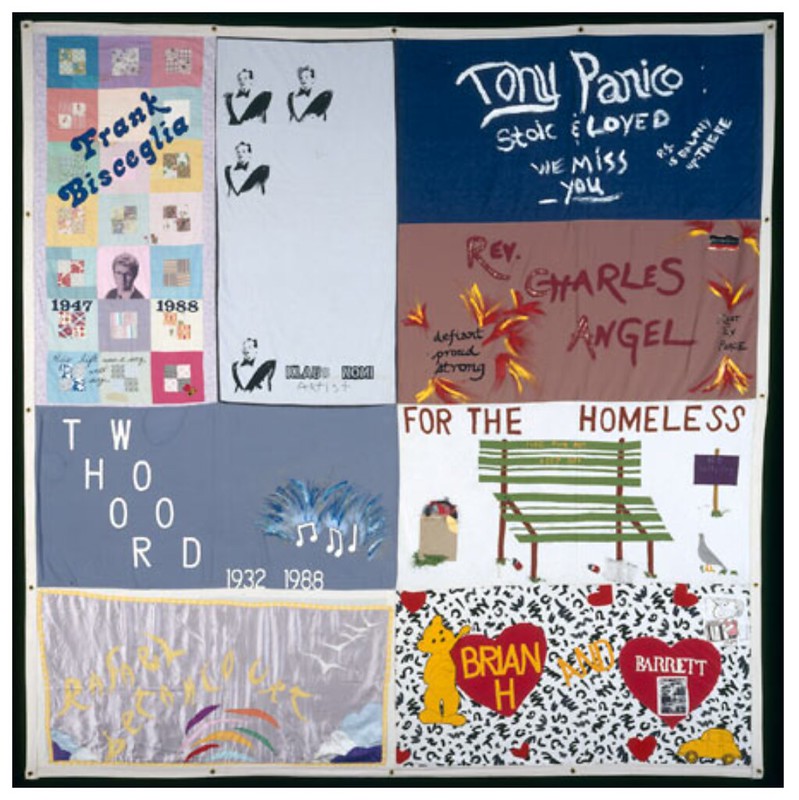
  • Tony Panico, my first lover in New York City, and the first person close to me to die from AIDS. His name appears twice on the AIDS Memorial Quilt, the first on Panel 05A when it was displayed in 1988. (AIDS Quilt Blocks 0046 and 0652)
  • Charles Pope, barfly extraordinaire
  • Gordon Provencher, 1955-1992 (AIDS Quilt Block 2291)
  • Tom Raleigh
  • Craig Rodwell, 1940-1993, founder of the Oscar Wilde Bookstore in Greenwich Village, NYC
  • Tony Rostron
  • Jurgen Schmitt
  • Giulio Sorrentino
  • Buddy Volani
  • Jeremy Wells
  • David Joseph Wilcox, 1957-1996
Tony's Quilt

Most of these men – including three of my ex-lovers – died before I was 35 years old. A fourth ex died in 2007. There are countless scores, hundreds, more whose names I did not know, whose fates I never learned, or who died since I stopped maintaining this list in 1994.

Related Content

Grief and Gardening: Ashes (Remembrance Day for Lost Species), 2019-12-02
One Score Years Ago, 2016-01-21
An earlier edition of this list: Names, World AIDS Day, 2009-12-01
David Joseph Wilcox, 1957-1996, 2008-01-22
In the Shadow (How shall my heart be reconciled to its feast of losses?), 2007-08-28
Back in the Day, about the Backroom BBS, my first online community, in the 1980s.
Grief & Gardening #1: 1, 5 and 25, 2006-09-04

Links

NY Times Obituary for David Kirschenbaum (PAYWALLED)
Wikipedia: Craig Rodwell
Reagan’s AIDS Legacy / Silence equals death, Allen White, SFGate, 2004-06-08, following Ronald Reagan’s death

World AIDS Day