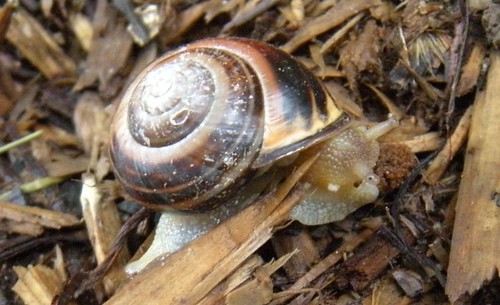
I was contacted on behalf of an urban nature educator who needs snails. She has a project this weekend on Governor’s Island to create snailariums. Who knew?! She got some snails, but not enough.
We are a neighborhood with a surfeit of snails. With yesterday’s rain, and more predicted today, it should be a good time to collect. If you’re interested in participating, see the original request from Wild Gotham Fran on the Brownstoner Garden Forum:
I am teaching a workshop at the Figment Arts Festival (6/11-13) on Governor’s Island on how to upcycle a shoebox into a posh house for a common garden snail. I am an urban nature educator and have a web show called Wild Gotham that focuses on everyday wildlife in NYC. If you have excess snails, I would love to come get them at your convenience or you could drop off at my house in Park Slope. Snails will be displayed at Figment and afterward released into my backyard where, along with all the others, they will devour my plants. Thank you in advance.- Fran
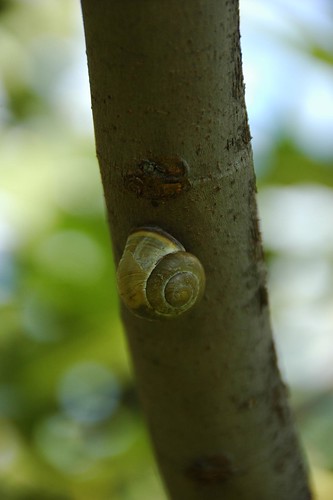
Tree Snail, Hattie Carthan Community Garden, Bed-Stuy, October 2008
Update, 2010.06.04: Added information about the site. Update, 2010.06.03: Added registration link.
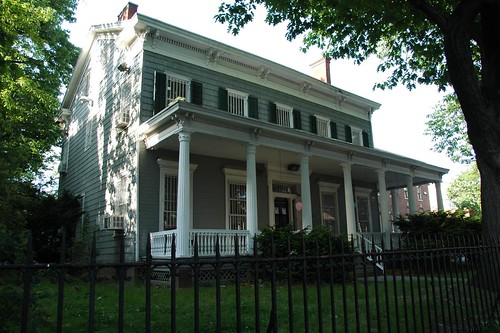
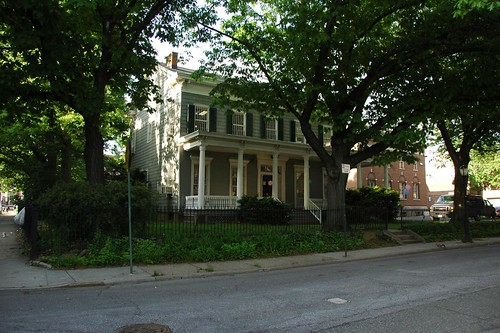
The Parsonage, Flatbush Reformed Church, 2103 Kenmore Terrace, corner of East 21st Street, Flatbush, Brooklyn Thus Sunday, June 6, from 4-6pm, we’ll be holding the first of two Community Visioning Workshops for a new communal garden on the grounds of the landmarked Flatbush Reformed Church. One site is a small, fenced-off area. The other is the front lawn of the Parsonage. This landmarked historic building was built in 1853 – though portions of it may be even older – and moved to this site in 1913.
Front lawn, looking east from East 21st Street
The main area is the front lawn of the Parsonage. It’s a large area, about 25-feet deep, from the fence along Kenmore Terrace to the porch of the house, and about 85-feet long, from East 21st Street to the Church parking lot. There are opportunities to further develop the buffer plantings, 3-1/2-feet between the fence and the sidewalk, that Church members have already established.
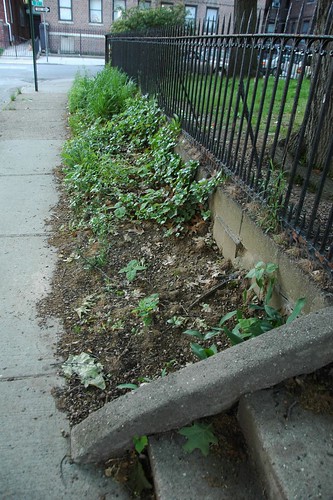
Buffer Plantings, looking from the entrance gate toward East 21st Street
The site is dominated by large, mature Oak trees lining the fence on Kenmore Terrace and East 21st Street. These cast dense shade, and working with this constraint will be one of the challenges for designing the garden and plantings. I have a lot of experience with urban shade gardens, and see the potential in this site.
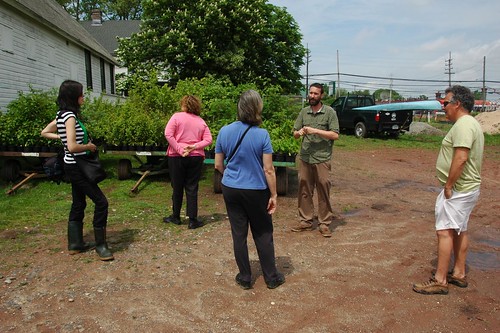
The most interesting aspects of this project will be the community partnerships. CAMBA, a large community-based service organization, has a young mothers program that meets at the Parsonage. We want the space and gardens to be child-friendly, and provide opportunities for exploration and learning about nature and gardening. The Flatbush Farm Share CSA distributes from the front lawn of the Parsonage. They offer shares for all income levels, and subsidize low-income members. We want to accommodate their needs for space and provide opportunities for education programs.
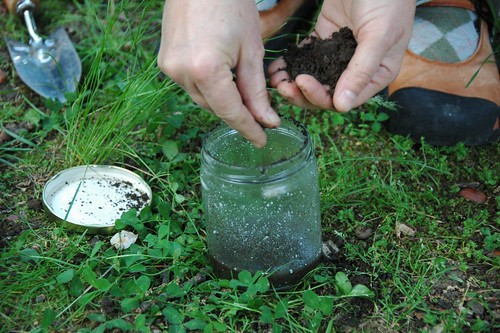
Soil Sampling for Texture Analysis
Press Release
Sustainable Flatbush is partnering with the Flatbush Reformed Church to create a new community garden! The whole community is invited to be involved in the planning and care of this neighborhood green space.
Two Community Garden Visioning Meetings have been scheduled for Sunday June 6th and Wednesday June 16th. At these brainstorming sessions community members will visit the garden area, located on church grounds, and work collaboratively to envision this new public green space: what can be grown, how to best utilize the space, how the garden will be built and maintained, what to name the garden, and how to be a part of it!
The new community garden is a joint project of Sustainable Flatbush’s Urban Gardens & Farms Initiative and the Flatbush Reformed Church.
The Urban Gardening and Farming Initiative works to foster community gardening efforts in Flatbush, promoting healthy local food, sustainable horticulture practices, and community building and beautification.
Sustainable Flatbush brings neighbors together to mobilize, educate, and advocate for sustainable living in our Brooklyn neighborhood and beyond.
Flatbush Reformed Church is a welcoming, inclusive and ecumenical Church in the heart of Brooklyn.
WHAT: Community Garden Visioning Meetings WHEN: Sunday, June 6th at 4pm and Wednesday, June 16th at 6pm. WHERE: Flatbush Reformed Church, located at 890 Flatbush Avenue at Church Avenue, just three blocks east of the Q train or three blocks west of the 2 train, Church Avenue stop.
The Greenbelt Native Plant Center is the only municipal native plant nursery in the country. It is a 13-acre greenhouse, nursery, founder seed and seed bank complex owned and operated by NYC Parks & Recreations Dept. Over the past fifteen years, the center has grown hundreds of thousands of specimens from locally collected seed of the city’s indigenous flora for use in restoration, and replanting projects and is currently developing bulk seed mixes for the city. The GNPC is a partner in the establishment of the first national native seed bank called Seeds of Success.
GNPC operates as a wholesale nursery serving primarily, but not exclusively, restoration projects around the NYC area. GNPC partners with other growers around the region. Not all their efforts go to NYC wild areas and parks; some go to other, nearby restorations, and they also receive plants of specific species when they don’t have the stock to meet the demand.
There are over 2,000 plant species native to the NYC area. GNPC currently propagates about 350, a remarkable proportion. That range is important; GNPC is not just in the business of species preservation, but also restoration of plant communities. That work requires sourcing of many different species, and the plant “palette” required depends on the goals of each project.
Collection
It all starts with the collection of seed from the wild. Collections are done throughout the region; NYC itself has over 8,700 acres in 51 nature preserves under its Forever Wild program. Wherever it comes from, the seed collection protocol links back to the mission of GNPC. As Tim Chambers, our guide for the tour, and GNPC’s Nursery Manager, explained to us, non-selection is the goal.
Use of plant materials from local populations ensures the success of ecological restoration or enhancement of natural systems. Our seed collection begins by employing internationally accepted protocols for collecting seeds from wild populations that capture the full genetic variability of a given plant population. Genetic variation is the basis for evolutionary success. – Mission, GNPC
Part of the protocol includes random sampling across a population. Collecting seed from the most vigorous plants, or those with the largest seedheads, or some other criteria, introduces unnatural, human selection. This distorts the evolutionary history captured in the genetic diversity across the population. The population grown on from those seeds will be less representative of the original, less adapted to the conditions in which the original plants were found, and less suitable for restoration efforts.
Collection must be distributed not just spatially across a population, but across time. A given population may have individuals whose seed ripens slightly earlier, or slightly later, than the bulk of the population. These outliers give the population as a whole more resiliency in the face of unusual or extreme conditions: a drought, an early frost, an unusual outbreak of insects. Seed must be collected throughout the ripening seasons to capture that diversity.
Processing
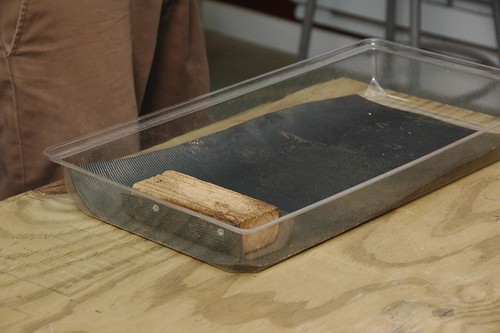
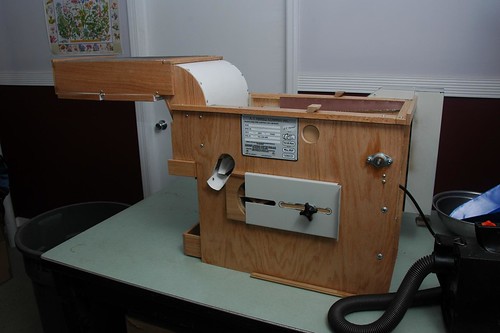
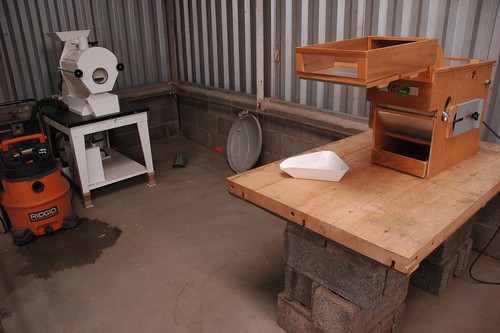
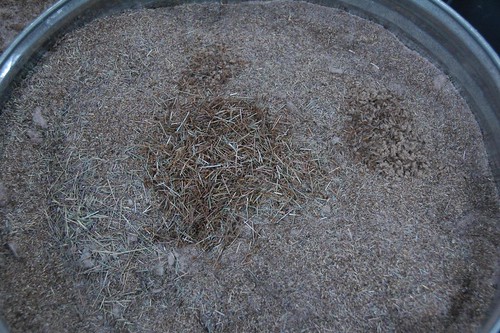
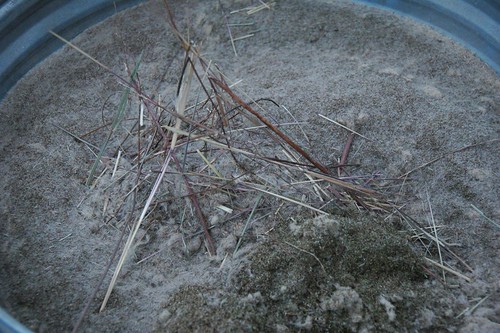
If you’ve never collected seed from your own plants before, I can recommend it. It’s not so straightforward as you might think. You don’t usually collect seeds. You collect the fruits that contain the seeds. Getting the seeds out – separating the seeds from the chaff – can take some work. And it requires different techniques for each species.
Separation Equipment
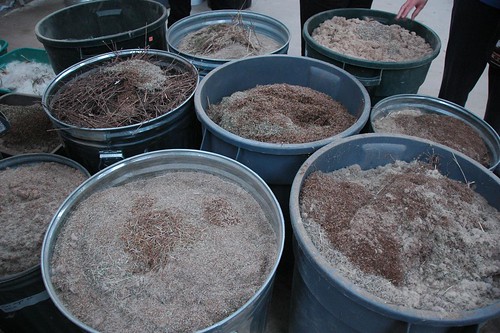
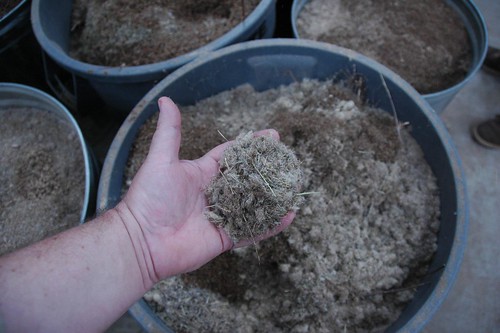
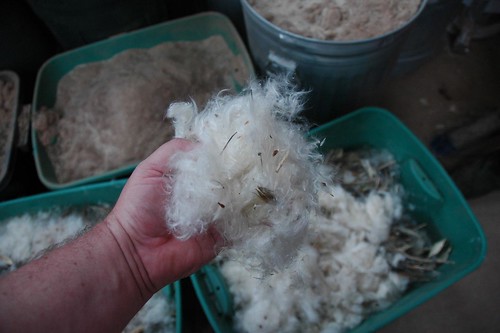
Barrels of Chaff
This chaff was softer than the softest feathers or wool you’ve ever felt.
Germination
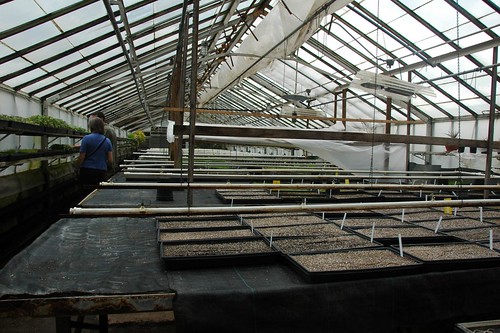
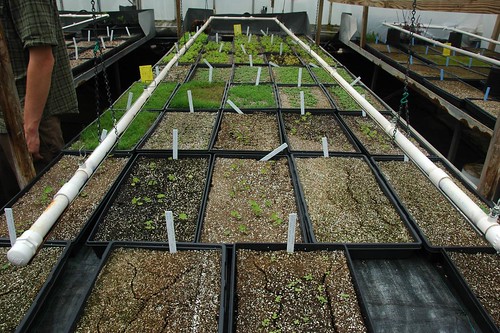
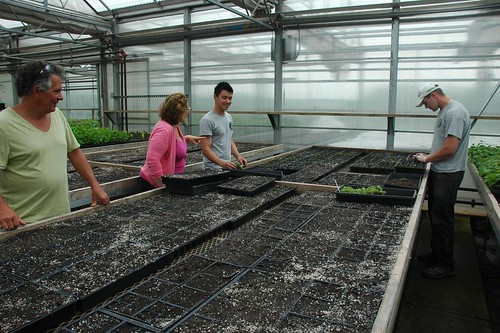
After separation, germination is tested in the Seed Lab. If germination succeeds, it means the seed is ripe; they sow the seeds in trays. They’re germinated and grown in a greenhouse dedicated to this first stage in getting plants from seed.
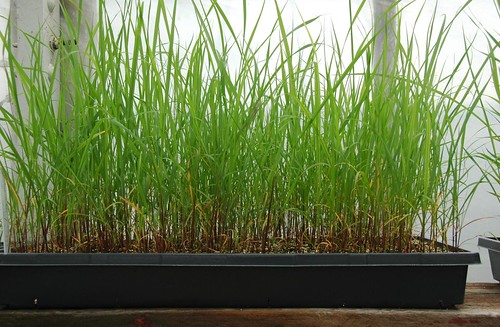
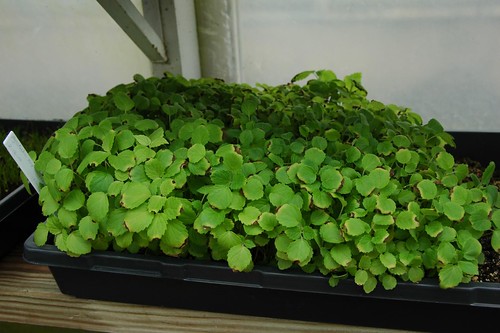
What results is a dense mat of first growth.
I didn’t get the id of these grass seedlings.
Amelanchier canadensis, Canadian Serviceberry
Agastache nepetoides, Yellow Giant Hyssop
Growing on
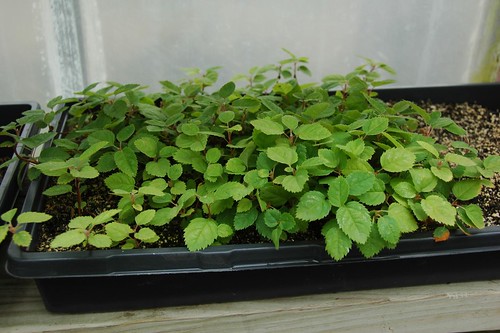
To grow past this point, the seedlings must be separated from their siblings. They’re pricked out from the mat and planted in individual containers, just like you find in any plant nursery. It’s delicate, time-consuming work.
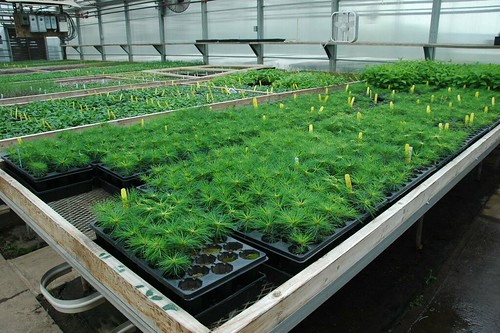
The result is an abundance of beautiful, healthy seedlings of NYC-local ecotype native plants. These will be grown onto successively larger containers, depending on the needs of the projects for which they’ve been contracted.
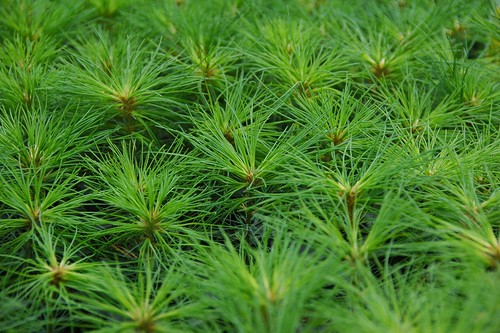
Pinus strobus, Eastern White Pine. Mature height: 150 feet.
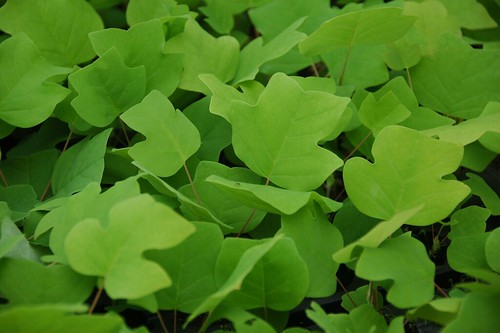
These cute little guys are Liriodendron tulipifera, Tulip Tree. Mature height: 120 feet.
It’s the week for the annual plant sale frenzy. All listed here are benefits for their respective gardens. It’s a great way to support your local gardens, meet other gardeners, and pick up some cool plants.
Saturday, May 1
Bay Ridge Narrows Botanical Gardens (NBG) 10am-3pm Annual Spring Plant Sale and Art Show (Rain Date: May 8)
Sunday, May 2
Kensington/Windsor Terrace East 4th Street Community Garden East 4th Street between Caton and Fort Hamilton Parkway 9:00 am to 1:00 pm Veggies, flowers and herbs
The Battery Plant Sale, April 2008, with spectacular views. That’s the Statue of Liberty there in the background!
Brooklyn Botanic Garden Annual Plant Sale Tuesday, 5/4: Members-Only Preview Sale Open to the Public Wednesday, 5/5 and Thursday, 5/6 Hours vary by date; see the BBG Web site for details
The Native Flora Garden at the Brooklyn Botanic Garden, May 2009. This was the first garden constructed after BBG was established on the site of a municipal ash dump 100 years ago, and the first public garden devoted to native plants. Next Wednesday’s tour of this garden with Uli Lorimer, curator of BBG’s Native Flora Garden and an instructor in their Certificate in Horticulture program, is one of over 45 FREE events in all – available during NYC Wildflower Week.
NYC Wildflower Week kicks off Saturday 5/1. This is the third year for the event, and it’s bigger and better than ever. There are events all over the city, including tours of locations otherwise closed to the public. I’m looking forward to visiting, for the first time, the Greenbelt Native Plant Center on Staten Island, “the only municipal native plant nursery in the country.”
From Friday, May 1, to Saturday, May 9, we’re celebrating the hundreds of native flowers, trees, shrubs and grasses in the Big Apple. Take advantage of the spring weather, and come out for a week of environmental learning, with free activities, walks, and talks galore.
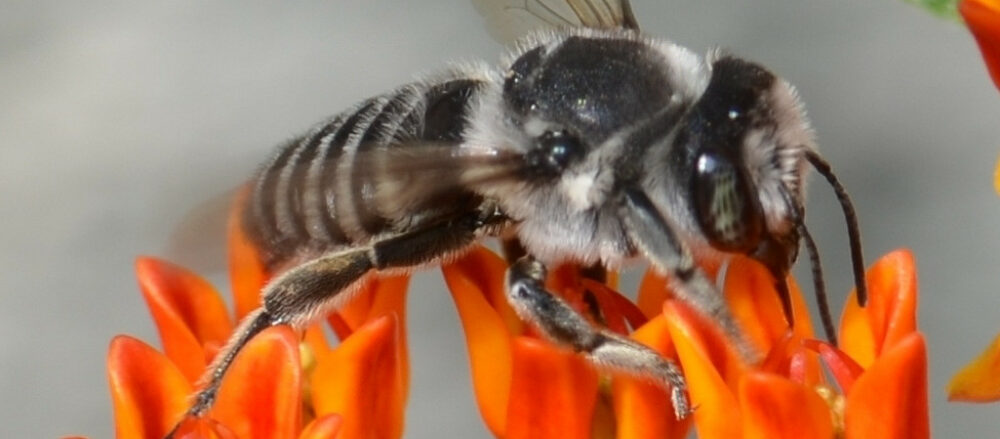
I’m proud that this year, for the first time, I’ve been invited to participate in an official capacity. This Saturday morning, May 1, I’ll be on-hand at the information booth at Union Square to help answer questions and provide information about native plants. A male Agapostemon, Green Metallic Bee, on a native perennial Helianthus, Sunflower, in my backyard native plant garden. Native plants provide vital habitat – food, forage, and shelter – for this and the rest of the more than 250 of bees native to NYC.
What can you do to help preserve NYC’s native plants?
Take a walk. Head outdoors with a field guide and a friend to learn about the botanical jewels in your neck of the woods. Preservation comes to those places that are loved by people.
Ride with the masses. Whenever possible, take mass transit. Let your legislators know how you travel. New roadways promote sprawl and destroy and degrade habitat. If this money were instead used to bolster mass transit, we could conserve oil, preserve biodiversity and decrease sprawl.
No picking. Removing native plants from the wild depletes natural populations. Never take plants from parks or other open spaces. An exemption – if a site were slated for development, then the plants should be rescued and moved to another site, but ONLY if you were absolutely certain that the plants would otherwise be destroyed.
Be civically active. Development is the #1 cause of native plant destruction. Make note of open space slated for a strip mall or housing complex or active recreation area (because even settings like ball fields and golf courses eat up natural habitats). Attend community board meetings. Voice your dissent. Open space allows for passive recreation, like plant hunting, birding and hiking. Such activities nurture the naturalist in all of us.
Preserve open space. Work to save our natural areas. Become a member of a local land trust or conservancy devoted to preserving open space and natural resources. If one doesn’t exist, consider starting your own.
Join a botanical society. New York, New Jersey, Pennsylvania and Connecticut all have native plant societies. These groups lead tours through local fields and forests and always welcome new plant people. See our Resources page to learn more.
Compost with care. Most homeowners believe it is environmentally responsible to pile lawn refuse (grass clippings, leaves, twigs) in adjacent open areas. Don’t. By dumping garden waste in woods or at property edge, you may be inadvertently overwhelming critical habitat for plants and animals!
Lay off the herbicide. Is it really that important to have a “weed free” yard? The struggle for pristine green carpet (aka lawn) is a struggle against nature itself. Herbicides kill the native plants on and around your property. Instead, keep turf to a minimum, and maximize color, richness and beauty with native plant gardens.
Legal protection for plants. New Jersey, New York, Pennsylvania and Connecticut all have something in common – none of these states have laws safeguarding native flora. Moreover, they have no legal protections for rare plants. An undeveloped lot chuck-full of uncommon and unique vegetation is not legally viewed as special. This site is just as likely to be built upon as a lot full of crummy weeds. This happens even at the Federal level, where most of the money from the Endangered Species Act goes towards animal protection. Let your legislators know that your flora should have rights. Flower power!
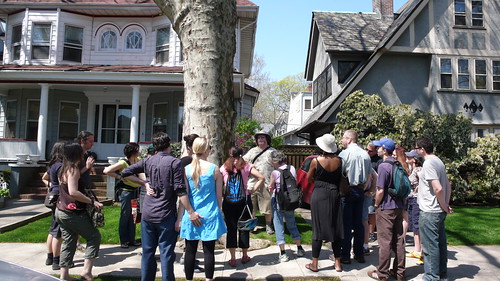
Sustainable Flatbush Street Tree Walking Tour, Arbor Day 2009. That’s me in the middle, next to the tree. Photo by Keka (Flickr)
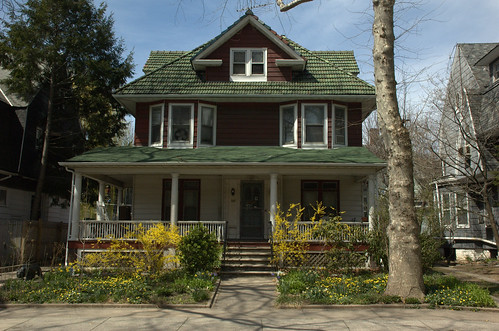
Tours start at 11am and 12noon from Sacred Vibes Apothecary, 376 Argyle Road, between Cortelyou & Dorchester Roads, and loop through the historic neighborhoods of Beverley Square West and landmarked Prospect Park South. In addition to architectural beauty, the area boasts a rich variety of street trees, as well as ornamental trees and shrubs.
Sophora japonica, Japanese Pagoda Tree, Scholar Tree
Tsuga canadensis, Eastern Hemlock
Ulmus americana, American Elm
… and many more.
The suggested donation for the tour is $5. From the Sustainable Flatbush Web site:
On Sunday, May 2, Sustainable Flatbush will host our fourth Street Tree Walking Tour! Join tour guides Chris Kreussling (better known as Flatbush Gardener) and Tracey Hohman (professional gardener) for a fun, fulfilling and enlightening tour of Brooklyn’s diverse canopy.
On the Street Tree Walking Tour, you will learn to identify a variety of trees (think of how you can impress your friends!), examine local natural tree history and tree lore (no textbooks needed!), explore the way street trees benefit urban areas (you’ll become a tree’s best friend), and find out how you can obtain and care for street trees yourself!
Become a street tree defender as you walk your way around Victorian Flatbush! The tour (recommended by Brokelyn as a great cheap date!) will take about two hours. Make sure to dress appropriately for the weather and the walk!
The Street Tree Walking Tour is about “connecting people to streetscape,” according to Chris Kreussling. Street trees remind us that we are not separate from nature, but instead dependent upon it for our survival and safety. So grab a friend — or three! – for the walk of the season, and fall more in love with the beautiful foliage of Brooklyn!
What: Street Tree Walking Tour Where: Begins and ends at Sacred Vibes Apothecary (376 Argyle Road, btwn Cortelyou & Dorchester Roads) When: Sunday, May 2 — two tours are scheduled: one at 11 a.m., one at noon
Suggested donation $5
Keep an eye out for Sustainable Flatbush’s Street Tree Walking Tour next fall!
Directions:
Take the Q train to Cortelyou Road Station and walk west after exiting the station toward Argyle Road.
As a reminder, check the MTA website for schedule and service advisories before you head out.
Buses that stop on or near Cortelyou Road include the B23, B103, B68, and BM1,2,3,4 and x29 express busess.
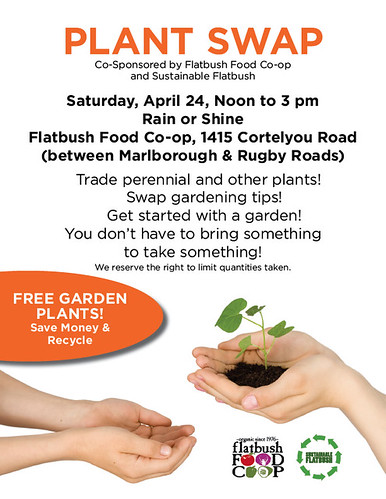
Got some perennial divisions or extra seed-starts you don’t need? Looking to start a new garden, and want some free plants? Looking to meet your gardening neighbors and pick up some tips?
Not the most ideal weekend to be digging in the garden, but if you’re lifting, removing or dividing perennials, or have extra seed-starts, bring them to the First Annual Great Flatbush Plant Swap next Saturday, April 24, in front of the Flatbush Food Co-Op.
Co-sponsored by the Flatbush Food Co-op and Sustainable Flatbush, this is an opportunity to share or swap plants, meet your gardening neighbors, and get some free plants.
When: Saturday, April 24, 12noon-3pm, Rain or Shine Where: Flatbush Food Co-op, 1415 Cortelyou Road, corner of Marlborough Road
Once again, MillionTreesNYC is offering free trees, first-come, first-served, at limited locations around the city. Trees must be planted in the ground, not a container or planter, within New York City. They can be planted on private property, with permission of the property owner.
Here are some Brooklyn locations. Check their Tree Giveaway page for the latest updates and other locations and dates around NYC.
SOLD OUT – All 200 trees were claimed in 1/2 hour Green Fort Green and Clinton Hill & FAB Alliance Giveaway Saturday April 17th and Sunday April 18th 10 am – 3 pm Putnam Triangle (Putnam Avenue & Fulton Street) Brooklyn, NY 11238
Grand Street Campus Giveaway Saturday, May 1st and Sunday May 2nd 10 am – 4 pm 850 Grand Street Brooklyn, NY 11211
April is MillionTreesNYC month. In addition to the tree giveaway, there are many other events and activities scheduled.
Earth Day Corporate Challenge (Thursday, April 22, 2010) – To celebrate the 40th anniversary of Earth Day, NYRP and City Year are joining forces for a second year to challenge some of New York City’s corporate leaders to plant more than 100 street trees in Upper Manhattan’s Washington Heights. To get your company involved, contact Jimmy Owens, NYRP Corporate Giving Manager, at (212) 333-2552.
NYC Parks Reforestation Day (Saturday, April 24) – more than a thousand community volunteers will join the NYC Parks Department in planting 20,000 trees in a single day at 16 park sites across the city’s five boroughs. To register to volunteer, visit www.milliontreesnyc.org.
NYC Grows (Sunday, April 25) – NYRP and the NYC Parks Department, along with presenting sponsor Organic Gardening magazine, invite New Yorkers to this annual, free outdoor festival that promotes community gardening, tree planting and care, urban farming and sustainable living. Tree-planting and care demonstrations will be provided throughout the day in the MillionTreesNYC pavilion area. To learn more, visit www.nyrp.org/nycgrows.
Arbor Day Celebration (Friday, April 30) – To commemorate Arbor Day, MillionTreesNYC lead sponsors The Home Depot Foundation, Toyota and BNP Paribas will bring their employees out to dig in and green a Brooklyn residential development. New York City residents are invited to celebrate Arbor Day by planting a tree in their yard or by adopting a street tree and watering and protecting it all year long. To learn more, visit www.milliontreesnyc.org.
MillionTreesNYC Lecture Series (Mondays in May) – To keep the MillionTreesNYC momentum moving beyond April, a series of lectures focused on innovations in tree planting and maintenance, public policy and urban forestry research will be presented each Monday throughout the month of May. For dates, times and locations of lectures, visit www.milliontreesnyc.org.
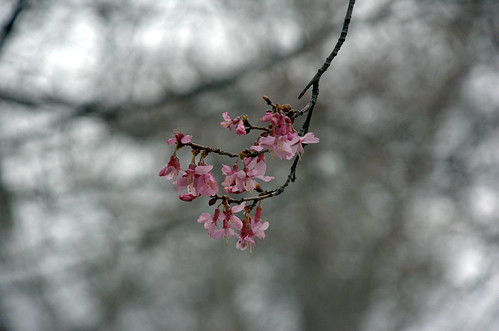
Cherry Blossoms, Brooklyn Botanic Garden, April 2007, All Rights Reserved
via BBG Press Release
From April 3 to May 2, Brooklyn Botanic Garden (BBG) celebrates Hanami, the Japanese cultural tradition of viewing each moment of the cherry blossom season, from the first buds to the pink blossoms that fall like snow.
During Hanami, visitors can take a free Seasonal Highlights Tour (Saturdays and Sundays at 1 p.m.) focusing on the ethereal beauty of BBG’s Japanese plant collections and specialty gardens, including the more than 220 exquisite flowering cherries, the C.V. Starr Bonsai Museum, and the Tree Peony Collection. Brooklyn Botanic Garden’s curator of the Japanese Hill-and-Pond Garden, Brian Funk, will also host a Meet the Curator session (Wednesday, April 14, at 4 p.m.). Throughout Hanami, the cherry display will be tracked in real time on BBG’s web-based CherryWatch feature, which maps the entire collection and provides daily blossom updates.
The four weeks of Hanami culminate in the Garden’s legendary two-day festival Sakura Matsuri — popularly referred to as “New York’s rite of spring” — a thrilling tribute to the Garden’s iconic collection of flowering cherries. Sakura Matsuri is scheduled for May 1 and 2, from 10 a.m. to 7 p.m. each day, with over 60 performances, demonstrations, and exhibits—many of which are new and specially commissioned for the dynamic weekend celebration. Visitors of all ages are welcome to Sakura Matsuri, the nation’s largest event in a public garden.
During Hanami, visitors can also enjoy a selection of special Japanese entrées at BBG’s Zagat-rated Terrace Café and discover the Hanami Collection at BBG’s Gift Shop (both on-site and online), featuring handpicked items inspired by the Garden’s blossoms and Japanese aesthetics.
Brooklyn Botanic Garden encourages all visitors to share their cherry blossom images in the Garden’s Hanami photo pool on Flickr.
BBG began charging admission in 1996. The weekend of Sakura Matsui accounts for 80% of their gate for the year.
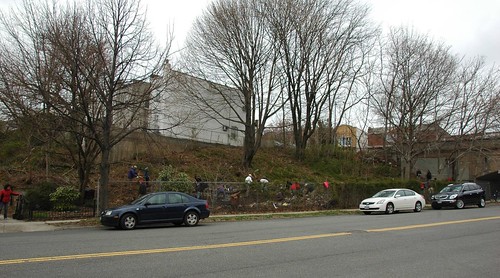
A new Brooklyn community farm/garden, christened “Windsor Farm,” broke ground Sunday, April 28 in Windsor Terrace. I went to lend my support, help out for a bit, and check out the scene.
It’s a challenging site, even for an urban garden. The aerial photography of Google Maps revealed that the site is completely covered by trees. It didn’t show that the property spans a steep slope.
Whatever this slope is, believe me, when you’re on the side of it using edge tools to cut through the brambles, it feels a lot steeper!
Even more challenging are the weeds, which include:
Ailanthus altissima, tree-of-heaven
Fallopia japonica, Japanese Knotweed
Gleditsia triacanthos, Honeylocust
Hibiscus syriacus, Rose-of-Sharon
Lonicera japonica, Japanese Honeysuckle
… and a few others I’m forgetting at the moment. I don’t know what annual species the seasons will reveal.
Fallopia japonica, Japanese Knotweed, at Windsor Farm. These stalks, 3-6″ high now, will grow to 8-9′ tall by the end of the summer, and produce thousands of seeds. On Sunday, the community volunteers began clearing the site, cutting and filling to terrace the slope, and removing debris. I don’t know the history of the site. I came across several piles of concrete and rubble that appeared to be construction debris rather than an on-site foundation. It’s possible that the site has endured some dumping, though there was no evidence I found of serious trash that has been overcome in the formation of other community gardens.