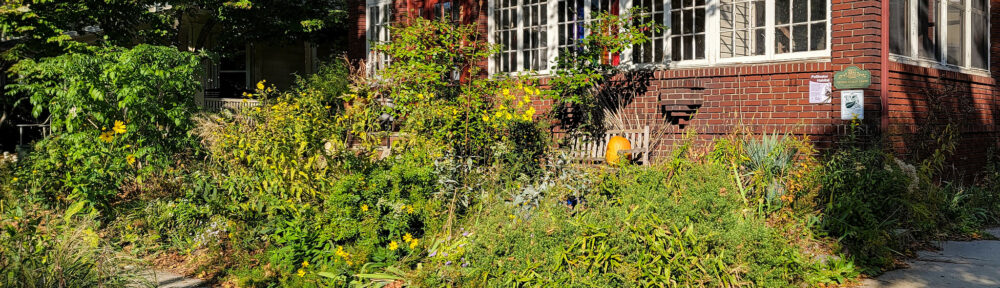
Growing a Native Plant Garden in a Flatbush Backyard

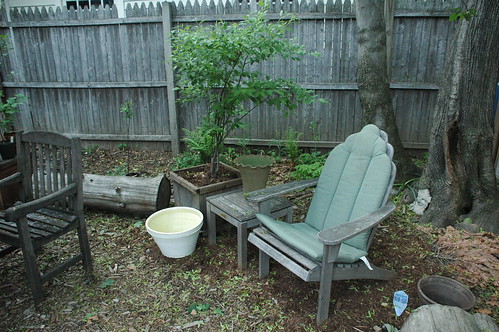
Gardener’s Corner, the Backyard Native Plant Garden, May 2007, Flatbush, Brooklyn.
Gardener's Corner

This past Winter, I wrote about the front garden and its changes so far. The backyard is getting jealous.

Collectively known as Victorian Flatbush, this area of Brooklyn is reputed to contain the largest collection of free-standing Victorian homes in the world: over 1,000. I keep seeing this factoid crop up, but I’ve yet to see any documentation backing it up.

In any case, most of these structures are the classic houses of children’s drawings, with peaked roofs and 6/1 or 1/1 double-hung sash windows. They are also fully “detached” houses, with exterior walls, and therefore gardening opportunities, on all sides of the house. Each side of our house has different exposures, full sun to shade. For the first time in more than 25 years of city gardening, I can grow just about anything somewhere around the house.

Over the past two years since we moved in, the backyard has become increasingly presentable. My ideas about what to do there, and what can be done, continue to evolve as I observe the seasons, the wildlife, and how people respond to the garden.

Spring 2005

Here are some photos showing how the backyard looked in Spring 2005, just after we moved in. (If the “after” photos below look a little roomier, it’s mostly because they were taken with a wider angle lens – and a better camera! – than I had available in 2005.)

At this time, the backyard was nothing but a weedy dustbowl. You wouldn’t know it from looking at these photos, but four (4) trees had just been removed from the backyard when I took these photos! You can still see the sawdust in some of the photos.

Looking South, toward the garage. Note the sawdust on the roof from removal of the tree which had been leaning against it. The crack in the garage wall at the rear of the garage (left in the photo) is damage from the tree growing under and pressing against it. There is also damage to the roof edge where the trunk made contact. You can also see a slope from from left to right, from the rear of the property toward the house. This is an indication of long-term drainage issues which will eventually require regrading of the surface away from the house.
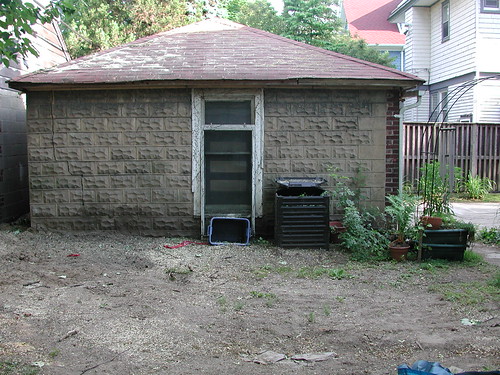
Backyard, view toward the garage

There had been another tree, which we also had to get removed, growing up between our garage and that of our back neighbor’s .

Looking East, toward our back neighbor. Roughly behind the green pole was another weedy maple tree growing up between our cherry tree in the center of the photo and another large maple out of frame to the right, near the garage.
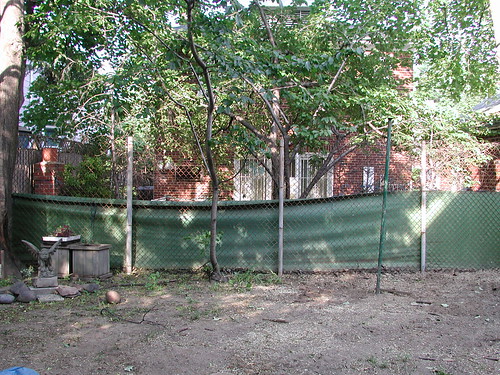
Backyard, view away from the house

Looking North, away from the garage, toward our next-door neighbor. The fourth tree – another weedy maple – was growing where the two sections of fence meet. You can see damage to the fence where the trunk was pressing and rubbing against it.
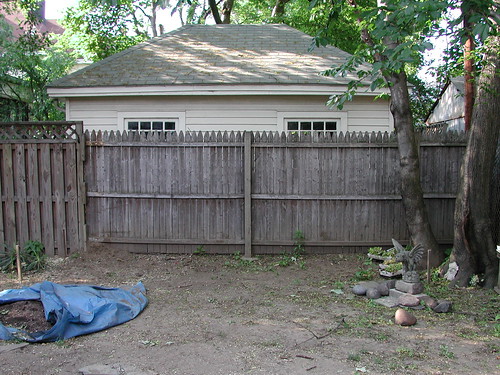
Backyard, view away from garage

Looking West, toward the house. This is a rear extension, extending 12 feet or so from the rear wall of the house. You can just see the bottom of my tree fort – the second floor porch – at the upper left of the photo. The greenery coming in from the right is our next-door neighbor’s apple tree.
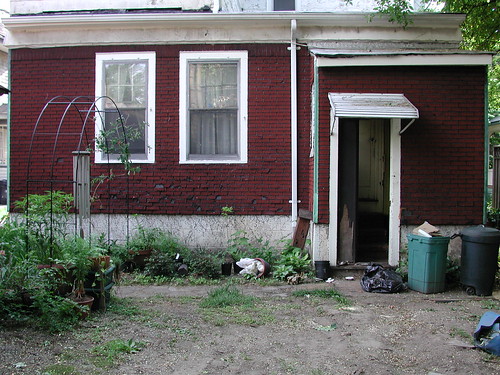
Backyard, view toward the house

The available space in the backyard is about 28 feet square. The garage takes up much of the width from side-to-side, and the sheltered doorway projecting into the backyard takes up much of the depth. From early on, I began thinking about how I might reclaim some of this space, physically and visually.

Summer 2005

This is a vision of what could be if we redesigned the ground floor of the house to connect it with the backyard. Arrows indicate traffic flows.

The rear extension of the house would be reconfigured to become a large, open plan kitchen the width of the house. This in turn opens up onto a full back porch. Physically and visually this would add more than 20 feet to the depth of the backyard. Steps would lead down from the porch to each side of the house and into the backyard. The dining room (DR) and living room (LR) would be unchanged, except for restoration of the pocket doors which used to join them.
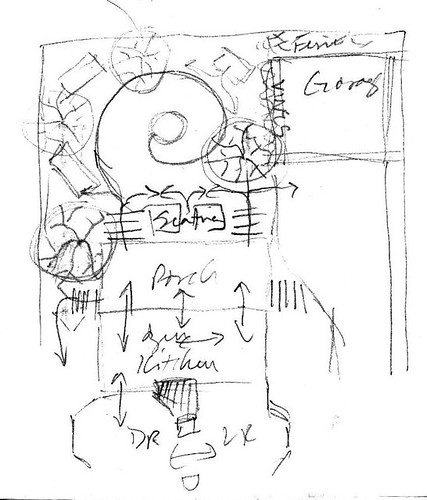
Backyard Garden Design Sketch

Spring 2006

By March 2006, I had cleared the backyard of most of its weeds and established the “campfire circle” which exists today. The logs came from a large Eastern white cedar (Thuja occidentalis) I had taken down from the front yard at the same time I’d had the backyard trees removed. That was a beautiful tree which had clearly been planted originally as a foundation shrub. It was taller than the house, and damaging the front porch. I hated having to have it taken down, and asked to keep several lengths of logs for a future project. For now, they make great seating, and add to the woodsy atmosphere the backyard is taking on.
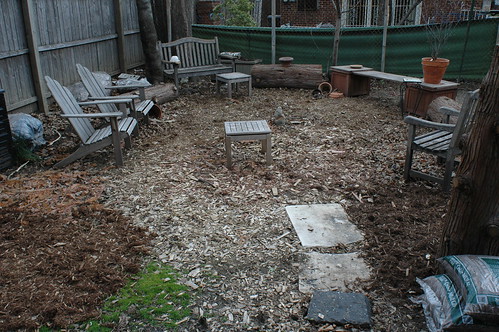
The Backyard

In April 2006, I sketched my ideas at that time for the backyard. Unlike the earlier sketch, this one accepts, for now, the existing structures – the garage, house and concrete path – and permanent plants – the two large maple trees and the cherry tree at the back of the property.

The proposed additions in this diagram are two large shrubs adjacent to the path (hatch marks) which runs along the back of the house, a fence with a gated trellis at the entrance from the driveway, and a trellis with a porch swing in front of the large maple at the corner of the backyard. The diagonal lines show the lines of sight from the swing area to the driveway and the street. The placement of the large shrubs would block the lines of sight, providing privacy and a sense of enclosure, bringing the backyard closer to contributing being a sanctuary.
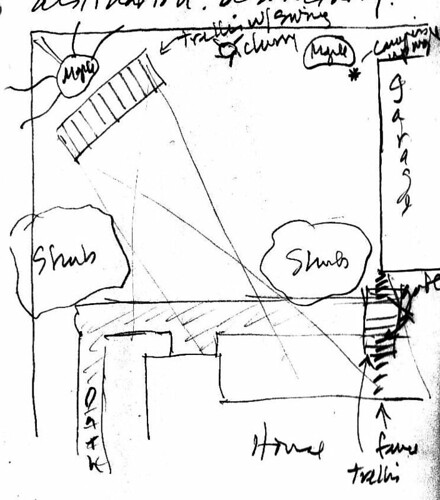
Backyard Garden Design Sketch

This photograph shows the view into the backyard from the driveway. No shrubs yet, but a simple metal trellis with a trumpet honeysuckle (Lonicera sempervirens cultivar) and a mature pokeweed (Phytolacca americana) do a fine job of filtering the view into the backyard. From the driveway you can’t see the “gardener’s corner” shown in the photo at the top of this post, right in front of the maple where the proposed porch swing would go.
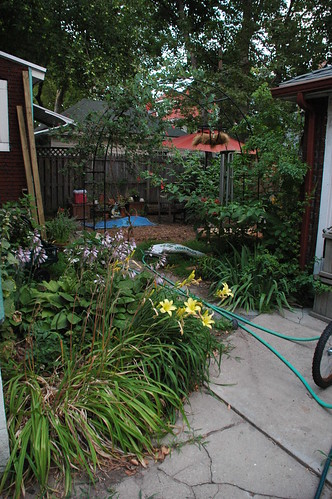
Filtered View into the Backyard from the Driveway

Summer 2007

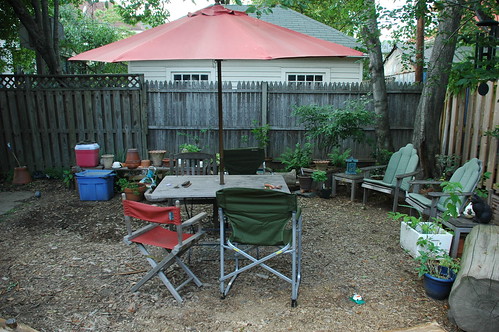
And here’s that weedy dustbowl as it stands today.

Looking South, toward the garage. Two of my three compost bins are hidden behind the screen at the left, next to the surviving maple near the garage. You can see the driveway through the trellis on the right.
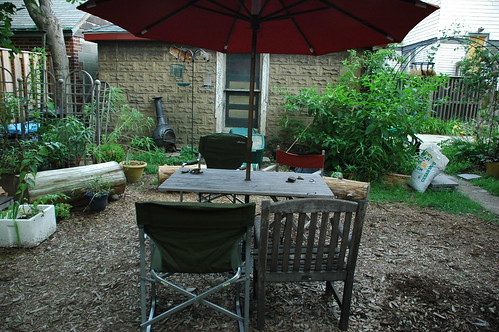
DSC_3193

Looking East, toward our back neighbor. They replaced their back fence, for which I am grateful. You can see where the compost bins are now, on the right side.
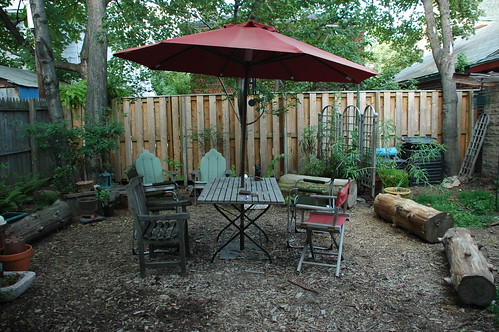
DSC_3190

Looking North, away from the garage, toward our next-door neighbor.
DSC_3191

Looking West, toward the house
DSC_3194

With all of this, I haven’t said much about the plants. It’s taken me weeks to put this post together, so I’ll stop trying to make it “perfect” and just send it out into the world. I’ll come back another time and show some of the plants I’m growing here.
Resources: Native Alternatives to Invasive Plants

As defined in U.S. Executive Order 13112 (Feb 3, 1999), an “invasive species” is:
1) non-native (or alien) to the ecosystem under consideration and
2) likely to cause economic or environmental harm or harm to human health.

Many, perhaps most (but not all) invasive plants were first introduced by gardeners as ornamental plants. For example, Ailanthus altissima, the Tree of Heaven, was cultivated as a shade tree. This is the “tree that grew in Brooklyn,” and the Brooklyn Botanic Garden even uses its image in its merchandise such as t-shirts and tote bags.

Not every plant which can become invasive is a risk in all areas. It helps to understand the ecological region and regime in which you garden and the threats to nearby natural areas. For example, the map of the Plant Provinces of North America in the BBG book Native Alternatives to Invasive Plants places New York City and Long Island in the province of Eastern Deciduous Forests rather than Coastal Plain Forests. Yet Long Island was built from millenia of glacial deposits; the area south of the southern terminal moraine – including most of Brooklyn – has more in common with coastal outwash plains than upland forests. Similarly, Brooklyn’s proximity to the ocean and the Gulf Stream moderates our temperatures compared to, say, the Bronx, the only borough on the mainland; our climate is a blend of Mid-Atlantic and New England as gardening goes.

Some states have taken the lead in making it illegal to sell, purchase, propagate or plant those species known to be invasive. Some gardeners, and nurseries, label such strategies “eco-fascism” and worse. I would support such legislation in New York, which has not yet joined the ranks of these states.

However, legislation should not be the sole strategy. Education must be a primary strategy. As gardeners, we can learn about the natural areas around us and the threats to them. We can avoid purchasing, propagating, planting or recommending plants known to be invasive. We can learn about alternative non-invasive or native choices for plants in our gardens. And we can educate others about these issues and possible solutions.

Mid-Atlantic

Kick the Invasive Exotic Gardening Habit with Great Native Plant Alternatives
National Arboretum

New England

Native Alternatives to Invasive Plants
University of Massachusetts at Boston
via Invasive Species Weblog

General

Native Alternatives to Invasive Plants (Excerpts from book)
Brooklyn Botanic Garden

Links

The Liberty Elm Project

Update 2007.05.29: Cornell University does not recommend Liberty Elm because:

‘Liberty’ is highly susceptibility to elm yellows and is not recommended due to variability of resistance to Dutch elm disease.
American Elm Cultivars (PDF), Recommended Urban Trees, Cornell Urban Horticulture Institute

Their top choices for American Elm Cultivars are “Valley Forge” and “New Harmony”, both of which they rate “resistant” to Elm Yellows and Elm leaf beetle, in addition to resistance to DED.


At last night’s 2nd Annual Brooklyn Blogfest, one of the highlights for me was getting interviewed by Dope on the Slope. He had some great gardening questions for me, and I hope I did them justice.

One thing I got wrong, though, was in response to his question about the American Elm, Ulmus americana. He mentioned that Home Despot is selling American Elms resistant to Dutch Elm Disease (DED). I responded that, although there are hybrids which are resistant, they’re not fully American Elms.

I Was Wrong

The Liberty elm is not a hybrid. ERI’s [Elm Research Institute] American Liberty elm is actually a group of six genetically different cultivars. All six look like classic, old fashioned American elms. …
About the American Liberty Elm

DED is caused by at least three fungi strains: Ophiostoma (Ceratocystis) ulmi, O. himal-ulmi, and O. novo-ulmi. At least two species of bark beetles – the native elm bark beetle, Hylurgopinus rufipes, and the European elm bark beetle, Scolytus multistriatus – serve as vectors for infection. American Elms, which used to be premier street trees across the country, were devastated by the disease since it reached U.S. shores on imported lumber in 1928. European Elms have been similarly affected.

The Liberty Elm, or American Liberty Elm, is the outcome of a decades-long research and breeding program to develop a strain of American Elm, developed only from American Elms, reliably resistant to DED. These are not inter-specific hybrids. They have been developed from survivors collected and propagated from across the country. The resulting plants are propagated vegetatively for distribution.

Genetic differences provide diversity. Having six cultivars in the series is insurance against all the elms being wiped out by any disease or problem, even one that might show up in the future. ERI mixes all six cultivars in its shipments.

During the research phase for all these new elms, they were challenged with injections of the Dutch Elm Disease (DED) fungus in controlled tests. But the American Liberty elm is now long past the experiment stages, and at this point it has been through the additional test of growing in public locations around the country for over 18 years, where it has been exposed naturally to DED fungus where it may occur in those environments.

There is no known American elm variety that can be called entirely immune to DED. The American Liberty elm is resistant to DED, and its resistance has a strong record. In the 18 years since the tree’s introduction, ERI has confirmed less than 100 cases of DED among the 250,000 elms it has sent out.

About the American Liberty Elm

Cornell University notes other DED-resistant cultivars available, including ‘Princeton’, ‘Independence’, ‘Valley Forge’, ‘New Harmony’ and ‘Jefferson’. They also note all of these elms are susceptible to Elm Yellows and should not be used where that disease occurs.

Any of you gardeners out there have any knowledge about these trees? Do you know of any growing in your area?

Native Plant Offerings at Gowanus Nursery

[Updated 2007.03.28 13:00: More notes, and started adding references.]
[Updated 2007.03.27 13:00: Added more notes, comments and links.]

I’m looking forward to the re-opening of Gowanus Nursery this Saturday. I really liked their old location on 3rd Street (I think it was) in Gowanus. Now they will be on Summit Street in Red Hook.

Their Web site indicates they will have the same great selection they had at their old location. Here are all the plants listed under Perennials, Native Species, on the Offerings page, along with some of my notes and comments.

  • Adiantum pedatum, Maidenhair Fern [My favorite fern, unlike anything else. I established a large colony of it in Garden #1 in the East Village.]
  • Amsonia hubrechtii ‘Blue Star’, Blue Milkweed
  • Arisaema draconitum Green Dragon
  • Arisaema triphyllum, Jack in the Pulpit [I grew this in Garden #1. It’s one of my favorite wildflowers.]
  • Aristolochia durior, Dutchman’s Pipe [Seems miscategorized, as this is a woody vine, not a perennial; dies this really grow back 30′ in one year? Correct botanical name is A. macrophylla, “big leaf”, which is certainly is. NYFA lists this as “Not Native” to New York state, with distributions in eastern Long Island and scattered upstate counties. I want to grow this up the side of our Victorian house. References: NYFA:150, PLANTS:ARMA7]
  • Asarum canadense, Wild Ginger [I grew this in Garden #1. Another favorite. Its foliage is its main garden contribution. I find the flowers interesting, but they’re hidden beneath the leaves.]
  • Asclepias tuberosa, Butterfly Weed [It’s sooo orange, this plant just makes me smile.]
  • Asplenium platyneuron, Harts Tongue Fern [A non-ferny fern, beautiful glossy green smooth leaves, it’s a great foliage contrast for other shade plants.]
  • Caltha palustris ‘Multiplex’, Marsh Marigold [double-flowered]
  • Camassia cusickii, Wild Hyacinth [Often available from bulb vendors.]
  • Chasmanthium latifolium, Northern Sea Oats [A native grass.]
  • Dryopteris erythrosora, Autumn Fern [There are several native Dryopteris, but this one’s a Japanese species, not native. Nevertheless, an excellent shade plant, it doesn’t go brown at the first touch of drought. I grew this in Garden #1.]
  • Erythronium americanum, Trout Lily/Dog Tooth Violet [A sweet ephemeral – it goes dormant in the summer – this is in the Lily family.]
  • Eupatorium ‘Little Joe’, Joe Pye weed [Butterfly and bee magnets. Presumably this is a dwarf variety. I prefer the tall varieties.]
  • Hepatica nobilis, Liverwort [I grew this under the name H. acutiloba in Garden #1.]
  • Iris cristata, Dwarf flag Iris [It’s picky about siting. I grew this in Garden and it moved with us. it thrived in both locations. I transplanted it last year and it vanished. Needs light mulch. Its rhizomes scramble over the soil surface, sending roots out and down. It languishes in a level area. It thrives when grown on a slight slope. Wants consistently moist, but not wet, soil.]
  • Liatris spicata, Gay feather [I love the common name, of course. It’s also a butterfly magnet. Long-blooming.]
  • Lonicera sempervirens ‘John Clayton’, [Trumpet] Honeysuckle [Long-blooming. I grew this yellow-flowering variety of the native trumpet honeysuckle at Garden #2 in Park Slope. It’s not as attractive to hummingbirds as the species and red-flowering varieties are, but it’s a beautiful plant in flower. I started growing a red-orange variety in Garden whose name I forget. It moved with us to my current gardens and bloomed into December last year.]
  • Matteuccia struthiopteris, Ostrich fern [Soft and feathery, this browns and crisps quickly without steady moisture.]
  • Mazus reptans
  • Meehania cordata [New to me. In the Mint family. Not native to New York.]
  • Mitchella repens, Partridge Berry [A delicate-looking groundcover. I’ve seen this growing in the wild, scrambling around the roots of hemlocks.]
  • Mitella japonica variegata, Miterwort [I don’t know this one, but japonica tells me it’s native to Japana, not North America. There are other species of Mitella native to New York state, but none native to NYC or Long Island that I can find.]
  • Opuntia humifusa, Prickly Pear Cactus [I want some of this!]
  • Osmunda cinnamomea, Cinnamon fern [Fiddleheads!]
  • Osmunda regalis, Regal Fern [Needs constant moisture, as it browns easily.]
  • Pachysandra procumbens, Allegheny pachysandra [So much more beautiful than the wretched common Pachysandra.]
  • Polygonatum biflorum, Solomon’s Seal [Another delicate-looking but tough woodland wildflower. Grow this in an elevated position so you can see the flowers, which dangle below the stems.]
  • Rhexia virginica, Meadow Beauty [Also new to me.]
  • Rudbeckia maxima, Giant coneflower [Of course I want to know: HOW giant? HOW maxima?!]
  • Sanguinaria canadensis, Bloodroot [I grew a lovely double-flowering variety of this which looked like white waterlilies in Garden #1.]
  • Scleranthus biflorus [I don’t know this one either.]
  • Spigelia marilandica, Indian Pink
  • Tellima grandiflora [Native only to Western and Northwestern states, not to the Northeast.]
  • Trillium grandiflorum [A classic wildflower, slow to establish.]
  • Uvularia perfoliata, Bellwort
  • Verbena ‘Snow Flurry’ [This seems to be mis-categorized as a “native species”. North Creek Nurseries identifies this as a hybrid yet also describes this as “Native to US”.]
  • Vernonia fasciculata, Ironweed [Good for bees and butterflies.]
  • Vernonia novaeborascensis, Ironweed [More for the bees and butterflies.]
  • Viola pedata, Birds Foot Violet
  • Waldsteinia ternata, Barren Strawberry

Related posts:

Links:

  • Drosera, the business Web site of Marielle Anzelone, has lots of plants lists, design tips, and other information for using native plants in New York City gardens.
  • The New York Flora Association Atlas and the USDA PLANTS Database are excellent tools for researching native plants and their distributions and characteristics. They also contain information about invasive plants.

Brooklyn Botanic Garden Signature Plants

Today I received my 2007 Catalog of Signature Plants from the Brooklyn Botanic Garden. This is one of the benefits of BBG membership I anticipate every year and serves as one of the markers on the gardening calendar. (Another such event is the annual plant sale the first week of May, a feeding frenzy of plant lust I hope to blog about this year.) It always arrives in mid-Winter; we finally had Winter this season, with mid-day temperatures in the teens the past two days. The catalog’s arrival reminds me that Spring is coming fast and I’d better start planning my garden renovations and acquisitions for the year.

Members contributing at the Signature level or above can select one or two plants from the catalog. Plants are grouped as Houseplants (tropicals hardy only to USDA Hardiness Zone 9 or higher), Perennials, and Trees and Shrubs. The listings describe 30 plants in just under four pages, with detailed information about the variety, cultural requirements, size, habit, and so on.

They also identify native plant species and cultivars. This year, they include:

  • Cornus sericea ‘Cardinal’
  • Fothergilla major ‘Blue Shadow’
  • Heuchera americana ‘Green Spice’
  • Itea virginica ‘Little Henry’
  • Kalmia latifolia ‘Ostbo Red’
  • Monarda fistulosa

Two years ago, they also offered local genotypes of species native to New York City, propagated in collaboration with the Staten Island Greenbelt. This is something I wish they would do every year. There are no commercial sources of locally-propagated plants available to the residential gardener.

Most years, I wait until late in the season to place my order, and never get my first choices. You, gentle readers, by your very presence, spurred me to email my first choices today. Here they are, with their catalog descriptions:

Rosa x odorata
China rose, butterfly rose (cultivar)
Hardiness: USDA Zones 6-9
Full Sun, Average soil; 3-6 feet tall

This antique shrub rose from China is celebrated for the chameleon-like color changes of its flowers (the “mutability” referenced in the cultivar name). Its cupped, single, slightly fragrant butterfly-shaped blossoms open a honey-yellow color, then turn coppery pink, then watermelon, then finally a rich mahogany. The floral display begins in May and repeats throughout the summer into fall. Orange hips form when the spent flowers are not deadheaded.

From the information I can find, this variety was introduced to the West from China “before 1894”, so it’s likely much older. It fits the criterion of being an antique/heirloom variety for the front garden. The size is right for this space; it will be easy to keep it low enough that it doesn’t detract from the brickwork, or block the view from the windows. Planting it at the south end of the planting area will give it nearly full sun during the summer. The early bloom is another bonus; I’m hoping to get the front garden, at least, on the Victorian Flatbush House & Garden Tour next year; it occurs June of each year.

Cotinus coggygria ‘Golden Spirit’
Smoke tree (cultivar)
Hardiness: USDA Zones 5-8
Full Sun to Partial Shade, Average soil, 8-15 feet tall

This smoke tree cultivar is grown for its unusual bright chartreuse-yellow foliage. The small, circular leaves retain their golden color until fall, when they develop magnificent tones of amber, burgundy, and scarlet. Smokelike grayish-green flower panicles appear in summer, typical of the species. An upright, loose-spreading, multistemmed deciduous shrub, ‘Golden Spirit’ works well as a single specimen or in mixed plantings. Grow it in average, well-drained soil in full sun.

I have this in mind for the south side of the house, along the driveway; you can see much of this garden in the Winter 2006 photo in The Front Garden Evolving. A large, deciduous shrub in this location will partially shade the south side of the house and provide privacy during the summer, when windows are open, and allow light in the windows during the winter.

Garden Diary: What’s blooming now

In the backyard and shady path:

  • Astilbe, two unknown varieties: one with dark red flowers, and one with white flowers
  • Dicentra eximia “Aurora”, White bleeding heart
  • Hosta, variety unknown: small, yellow leaves, purple flowers, could be “Gold Drop”? (just starting to bloom)
  • Hydrangea, variety unknown: white, lacecap type flowers
  • Ilex verticillata “Southern Gentleman”, Winterberry, male (in container)
  • Itea “Little Henry”, Sweetspire: white flowers (in container)
  • Kalmia “Peppermint”, Mountain laurel: white flowers with dark red rays (just ending)
  • Lonicera sempervirens, trumpet honeysuckle: dark orange-red flowers (just ending)
  • Tradescantia “Sweet Kate”, Spiderwort: Chartreuse foliage, bright purple flowers

In the sunny border:

  • Alcea, Hollyhocks, unknown strain: tall, pink flowers, white flowers
  • Asclepias tuberosa, Butterfly weed: Bright orange flowers
  • Campanula trachelium “Bernice”, Bellflower: Double purple flowers
  • Coreopsis verticillata “Zagreb”, Tickseed: Orange-yellow flowers
  • Digitalis, Foxglove, unknown variety: White flowers (just ending)
  • Hemerocallis (fulva?), Day lily: Bright orange flowers with brick red interior rays
  • Heuchera, Alumroot, unknown variety: white flowers, silver-variegated burgundy foliage
  • Ilex verticillata, Winterberry, female: White flowers, bright red berries still persisting from last year
  • Monarda didyma “Gardenview Scarlet”, Beebalm, Bergamot: Dark red flowers
  • Tradescantia, spiderwort: dark purple flowers

In the front of the house:

  • Centaurea, Bachelor’s buttons: Cornflower blue flowers
  • Dianthus caryophyllus Super Trouper Dark Violet, Carnation (windowboxes)
  • Heuchera, unknown variety: White flowers, burgundy foliage overlaid with white
  • Penstemon “Husker Red”: White flowers
  • Lavandula, Lavender, unknown variety: dark purple flowers
  • Thymus, Thyme: Pale purple flowers
  • Viola, Pansies: Large chrome yellow flowers with purple marks in the centers

Article, Fall 2005: The Changing Flora of the New York Metropolitan Region

The authors compare past distribution data from historical records, and current data from Brooklyn Botanic Garden’s New York Metropolitan Flora Project to determine changes in distribution over the past century. They further compare these changes between native and introduced species within the same genus, such as Celastrus scandens, American bittersweet (native) and Celastrus orbiculata (or C. orbiculata), Oriental bittersweet (introduced, and invasive), or Lonicera sempervirens, Trumpet honeysuckle (native) and Lonicera japonica, Japanese honeysuckle (introduced, and invasive).

We statistically analyzed 100 years of herbarium specimen data for woody plants in the New York metropolitan region in order to measure the floristic changes of this area. Change Index values were computed for 224 of the region’s 556 woody species to provide a specific measure of whether these species are expanding, contracting, or stable. The results show that, in general, nonnative invasive species are spreading rapidly in the region, while native species are in slight decline.
The Changing Flora of the New York Metropolitan Region

Links

The Changing Flora of the New York Metropolitan Region, Urban Habitats, Volume 3, Number 1, Fall 2005, Brooklyn Botanic Garden, 1000 Washington Avenue, Brooklyn, NY 11225

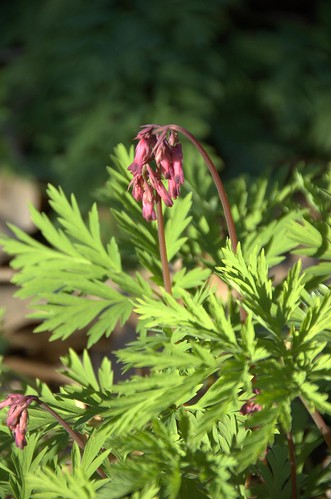
Dicentra eximia, Eastern Bleeding-heart

Dicentra eximia, Wild Bleeding-heart, Eastern Bleeding-heart, in the Native Flora Garden of the Brooklyn Botanic Garden
Dicentra eximia, Bleeding-Heart, Native Flora Garden, BBG

I first grew this plant in Garden #1 in the East Village. It was extremely long-blooming, blooming for months in the partial shade of the widlflower garden there. It forms a large clump over time. The ferny foliage is very effective and interesting when the plant is not in bloom.

This plant is probably NOT native to New York City. The NYFA Atlas notes:

The native status of this plant is questionable. It is clearly planted and escaping in various areas. Some of the populations on Staten Island, and possibly elsewhere in southeastern New York, appear in “natural” areas. These may represent native populations, or they may be escapes from nearby residential developments.

Slideshow

Related Content

Flickr photo set

Links

NYFA Atlas: Plant ID 1531
USDA PLANTS Database: Symbol DIEX

Liatris spicata, Dense Blazing Star

Liatris spicata, Dense Blazing Star, Marsh Blazing Star, Dense Gayfeather

You gotta love a plant called “Gay Feather”!

I first grew Liatris in Garden #1 in the East Village. It grew well even in the partial shade of that garden. The tall purple spikes were effective for a couple of weeks, and always drew comments from visitors.

Note that both the NYFA Atlas and USA PLANTS maps for this species show scattered distribution among New York counties, and only in Queens within New York City. NYFA Atlas list this species as NOT native to New York state.

References

NYFA Atlas: Plant ID 258
USDA PLANTS Database: Symbol LISP

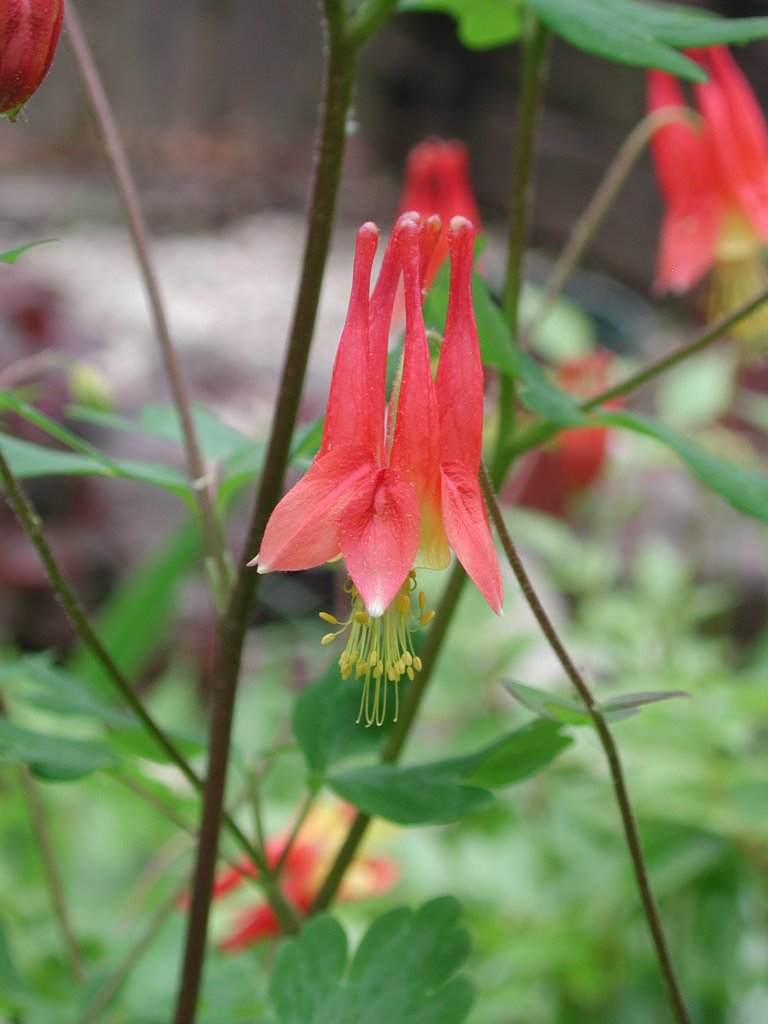
Aquilegia canadensis, Eastern Red Columbine

Macro photo of a single Columbine flower blooming in the backyard at Garden in Park Slope.
Photo taken: May 8, 2004

Aquilegia canadensis, Eastern Red Columbine

One of my favorite native plants and wildflowers. It looks so delicate, yet it blooms early spring, when temperatures are still cool.

Tips for growing, based on my experience growing Columbine in several gardens over many years:

  • Columbine likes to grow among rocks. In the garden, bricks, stepping stones, and paths are good substitutes.
  • Blooms early-mid spring, before trees have fully leafed out. If you keep the seedheads pinched back, you can keep it blooming for two months.
  • Larger plants don’t transplant well. Columbine has a fleshy root which is easily damaged in transplanting. It tends to not form a root ball, which makes it difficult to avoid damage and get the plant re-established in its new location.
  • Columbine is not a long-lived plant. Five years is a long time for a single plant. However, you can easily get more plants than you need through seed propagation.
  • Where you want Columbine to grow, plant one plant and let it go to seed. You can also collect seed from your plant and scatter it where you want more. Seed must winter over to germinate. It may take a year or two for new plants to establish themselves before they bloom.
  • Leaf-miner can be a problem; I find it’s less of a problem with the species than with hybrids. The miners tunnel inside the leaves, beween the upper and lower surfaces, as larvae. They create distinctive widening, wandering trails; hold a leaf up to a light and you can actually watch the larvae chewing away inside the leaf. When they’ve had their fill, they cut a hole through the underside of the leaf, pupate, and drop into the soil. They emerge as flying adults to mate and lay eggs in new leaves. Dispose of affected leaves in the trash; don’t compost leaves or affected plants or soil unless you know your compost gets hot enough for sterilization.

[TinyURL]

Links

NYFA Atlas: Plant ID 2583
USDA PLANTS Profile: Symbol AQCA