Earthrise over the moon as seen by the astronauts of Apollo 8 on December 22, 1968.
This was not the first image of the isolated Earth from space. It was the first which contrasted in the same image the wet, blue and green, atmospheric Earth with the barren, dusted, lifeless Moon.
The rising Earth is about five degrees above the lunar horizon in this telephoto view taken from the Apollo 8 spacecraft near 110 degrees east longitude. The horizon, about 570 kilometers (250 statute miles) from the spacecraft, is near the eastern limb of the Moon as viewed from the Earth. On the earth, the sunset terminator crosses Africa. The south pole is in the white area near the left end of the terminator. North and South America are under the clouds. The lunar surface probably has less pronounced color than indicated by this print.
Update 2011-04-16: As nasty as the weather is as I update this on Saturday night, it will be beautiful tomorrow for the tour, windy, but temperatures reaching into the upper 50s and low 60s. Added a Google Map of the tour below.
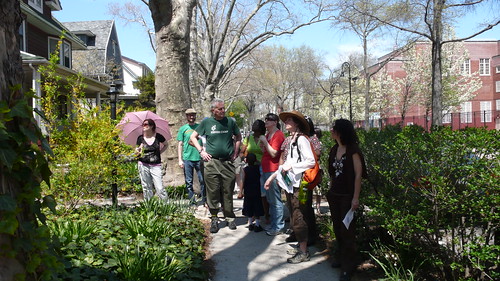
The Sustainable Flatbush Street Tree Walking Tour of April 2009. Photo: Sustainable Flatbush (Flickr)
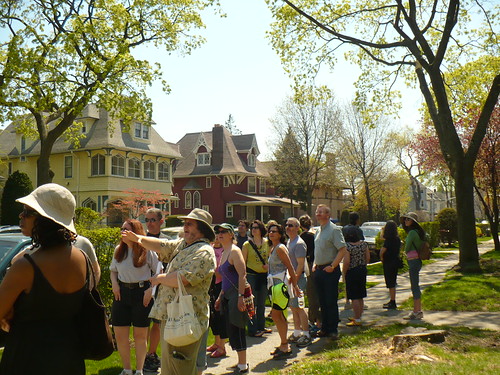
The 4th Annual Sustainable Flatbush Street Tree Walking Tour will be Sunday, April 17, the day after the Plant Swap. (It’s a busy weekend for us!) We’re following the same route as past tours, so if you’ve only been able to enjoy our fall foliage in the past, come enjoy the spring blooms!
Once again tours leave from Sacred Vibes Apothecary at 11am and 12noon. Your tour guides will be Sam Bishop of Trees NY, neighbor and gardener Tracey Hohman, and me. On the tour, you can see:
Acer platanoides, Norway Maple
Aesculus hippocastanum, Horsechestnut
Amelanchier, Serviceberry
Betula nigra, River Birch
Cercis canadensis, Redbud
Cornus florida, Flowering Dogwood
Cryptomeria japonica, Japanese Red Cedar
Ginkgo biloba, Ginkgo
Gleditsia triacanthos, Honey Locust
Liquidambar styraciflua, Sweetgum
Metasequoia glyptostroboides, Dawn Redwood
Pinus strobus, White Pine
Platanus x acerifolia, London Plane
Pyrus calleryana, Flowering Pear, Callery Pear
Quercus palustris, Pin Oak
Quercus robur ‘Fastigiata’, Columnar English Oak
Styphnolobium japonicum (Sophora japonica), Japanese Pagoda Tree, Scholar Tree
Taxodium distichum, Bald Cycpress
Tsuga canadensis, Eastern Hemlock
Ulmus americana, American Elm
… and many more. When: Sunday, April 17. Tours set out at 11am and 12noon. The tour lasts 90 minutes to 2 hours. Where: Tours leave from Sacred Vibes Apothecary, 376 Argyle Road, just down the corner from Cortelyou Road, across the street from the Tot Lot, catty-corner from the Greenmarket. The route is about a mile in length, looping back to where we started. Suggested Donation: 5$
As we approach the Second Annual Great Flatbush Plant Swap, I’m hoping to post some tips on how to divide perennials to bring to the event. Now is the time to do it, as foliage has just emerged, plants are actively growing, and most will recover quickly from any perceived insult of being lifted out of the ground and ripped into pieces.
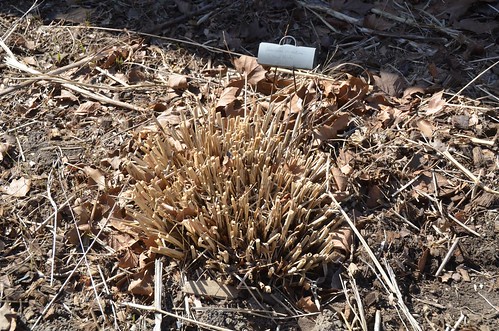
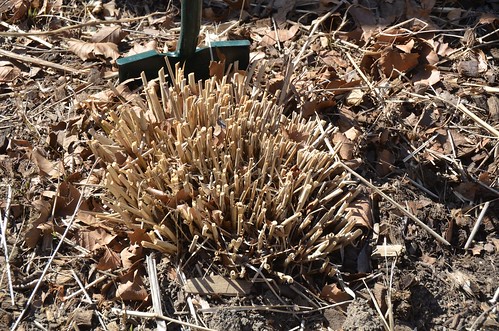
I have to do with this with perennials in my gardens, so I’ll use them as examples. Today I divided one of my larger grasses. This is a three-year old clump of Panicum virgatum ‘Cloud Nine’, a cultivar of our native switchgrass I ordered from Plant Delights in Spring of 2008. Two weeks ago, I cut back all the dead foliage from last year, leaving the stubble you see here. The clump is roughly a foot in diameter. This is ready to be divided.
One way to divide is to slice into the plant while it’s still in the ground with a garden spade, taking out slices as if it were a cake. I’ll use that technique on some of my Hemerocallis, Daylilies. Today, I chose to lift the entire clump out of the ground to separate it using two garden forks. This also made it easier to photograph to demonstrate the technique.
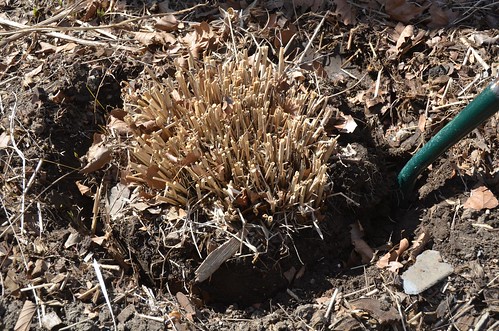
Clumping grasses like Panicum often have deep roots, contributing to their general drought-tolerance. To keep enough of the roots, first cut straight down with a deep-bladed garden spade, all around the perimeter of the clump.
With the perimeter cut, slice beneath the clump to sever the deeper roots. This took a bit of work until I was able to loosen the clump and fork it out of the ground.
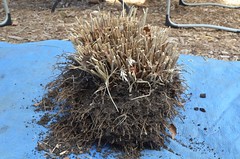
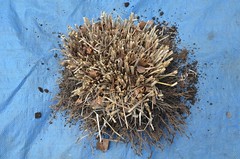
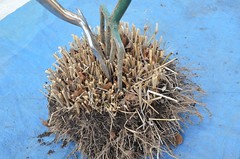
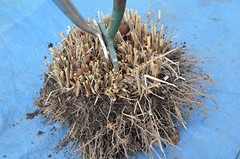
Here’s the intact clump, viewed from the side and from above, set on a tarp for division. Note how deep and dense the roots are, even after severing them with the spade.
Next take two garden forks. (If you don’t have two forks you could divide the clump with the garden spade at this point.) Place the heads back-to-back, with the handles slightly offset from each other, and drive them down their full length into the center of clump. Note that both heads go straight down, and the handles are splayed out from each other. That provides the leverage you need to separate the clump.
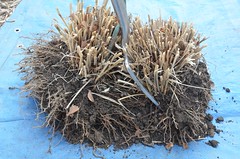
Keeping the tops of the fork heads against each other as a pivot, push the handles toward each other. You’re using the forks as levers to spread and break apart the clump. Push from both sides. If that’s awkward, try standing with one fork toward you, the other away, then push the closer fork away while pulling the further fork toward you. Watch your fingers! When the clump gives, it will release quickly, bringing the handles – and your knuckles – together. Gloves help! Once it gives, simply tease the two halves apart to complete the separation.
It looks like mitosis!
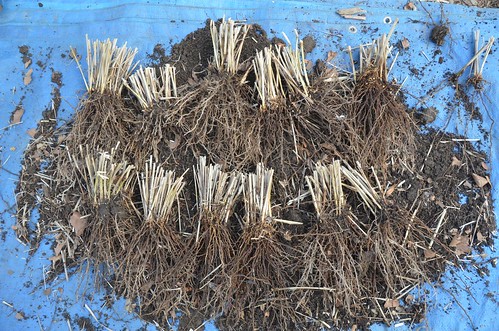
With a large clump like this, I repeated the same process on each of the two halves. I was then able to break apart the four quarters into smaller pieces by hand, giving me a dozen generously sized clumps to replant in my garden and share at the Plant Swap. Some of them will also go to the new native plant gardens for the Flatbush Reform Church communal garden, another project of Sustainable Flatbush.
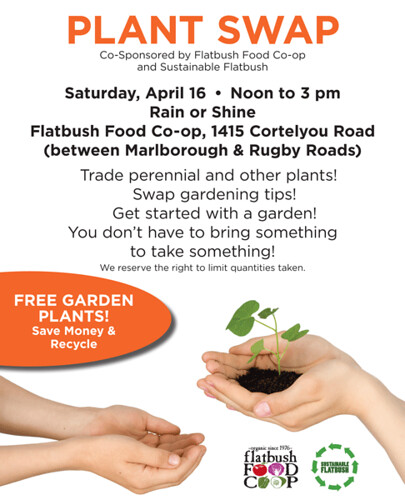
Do you have extra seed-starts? Leftovers from dividing perennials? No place for that shrub you just dug out? Bring them to the Second Annual Great Flatbush Plant Swap on Saturday, April 16. No plants? No problem: everyone can bring home a plant, even if you have none of your own to swap. And it’s a great way to meet other local gardeners, whether you’re a beginner or a pro.
Sponsored by Sustainable Flatbush and the Flatbush Food Coop, the First Annual was, coincidentally, just last year. It was a great success, especially for an inaugural event: we distributed over 330 plants. Let’s see if we can distribute even more this year!
When: Saturday, April 16, noon to 3pm Where: Flatbush Food Coop, 1415 Cortelyou Road, at Marlborough Road
2nd Annual Great Flatbush Plant Swap 12noon to 3pm Flatbush Food CoOp 1415 Cortelyou Road, Brooklyn Sponsored by Sustainable Flatbush and the Flatbush Food Coop
Millions Trees NYC Tree Giveaway Neighborhood Housing Services of East Flatbush noon – 2:00 p.m. Holy Cross Church School Yard 2530 Church Ave., Brooklyn
Sunday, May 15
My garden will be on tour for NYC Wildflower Week!
Saturday, June 4
Millions Trees NYC Tree Giveaway Cypress Hills Local Development Corporation 11:00 a.m. – 1:00 p.m. Blessed Sacrament Church 198 Euclid Avenue, Brooklyn