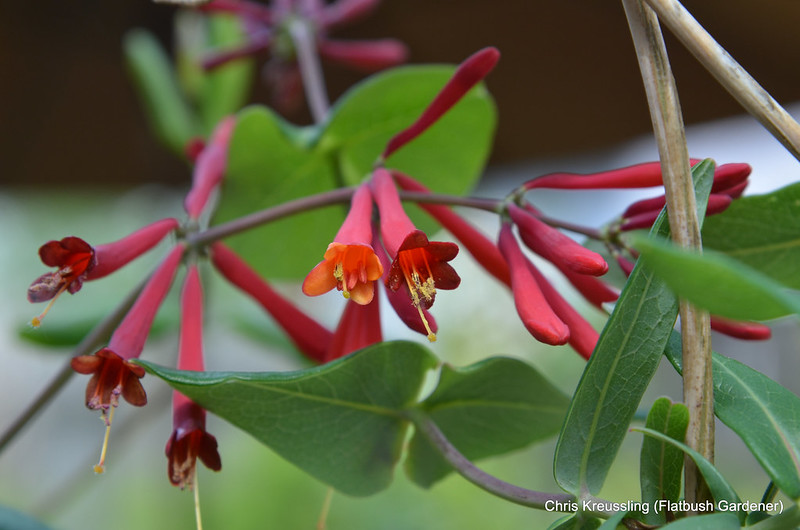
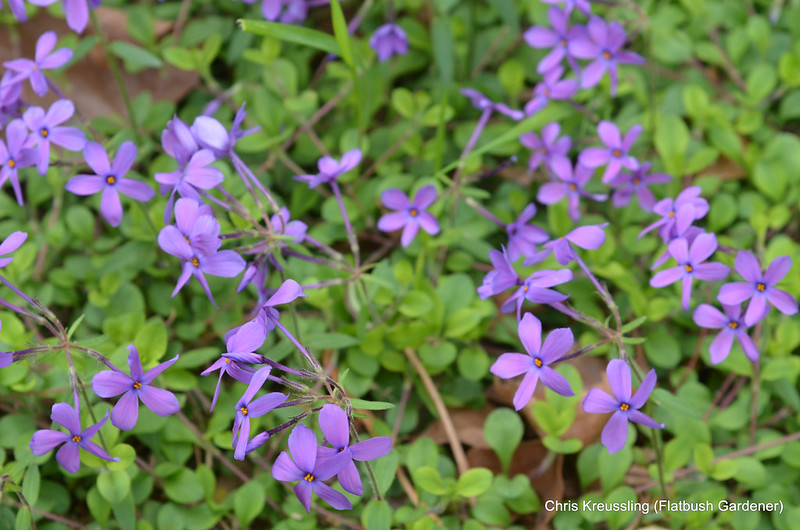
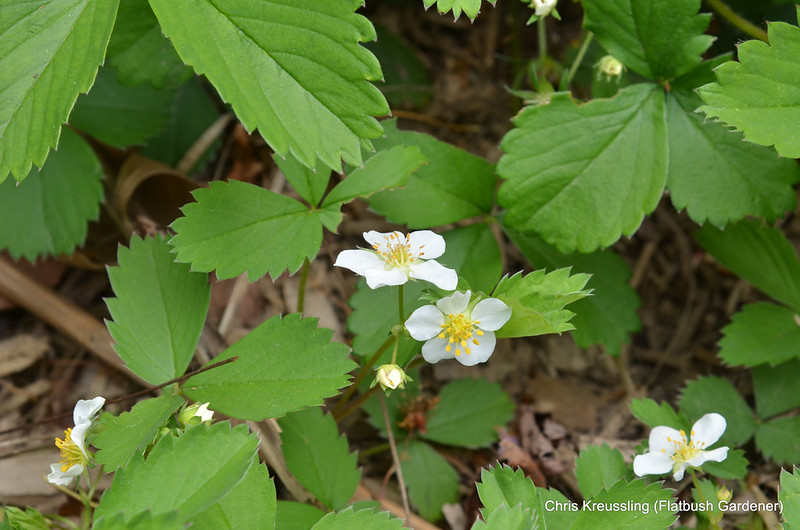
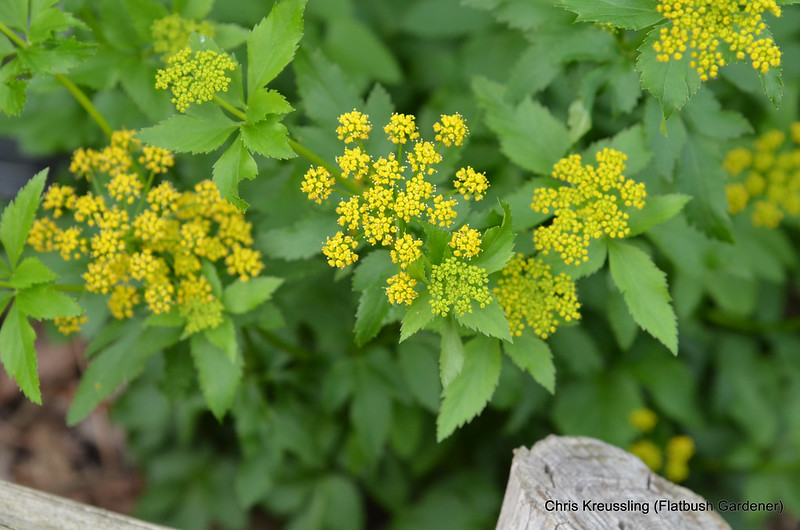
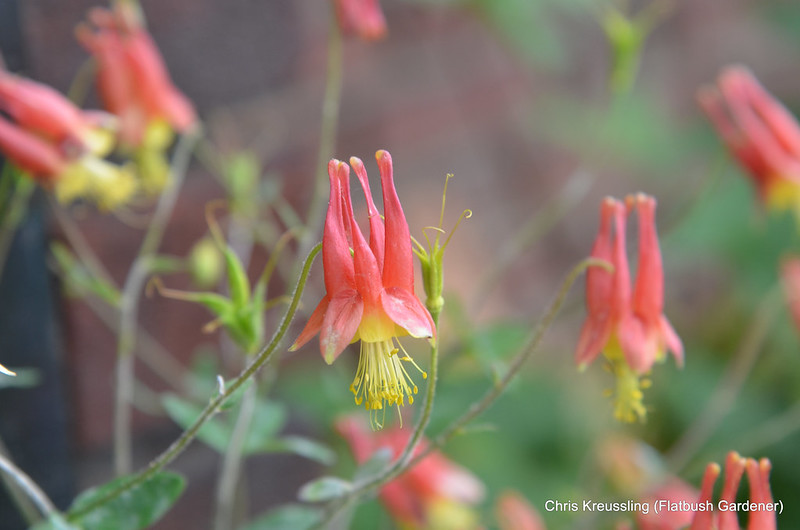
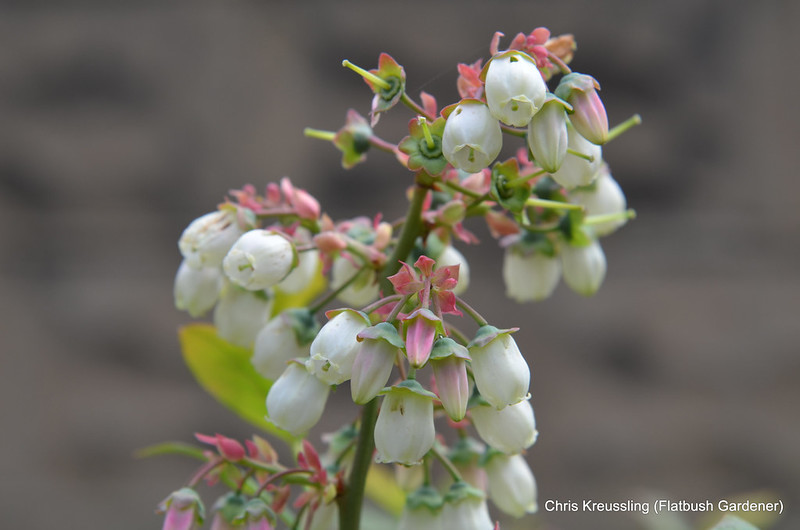
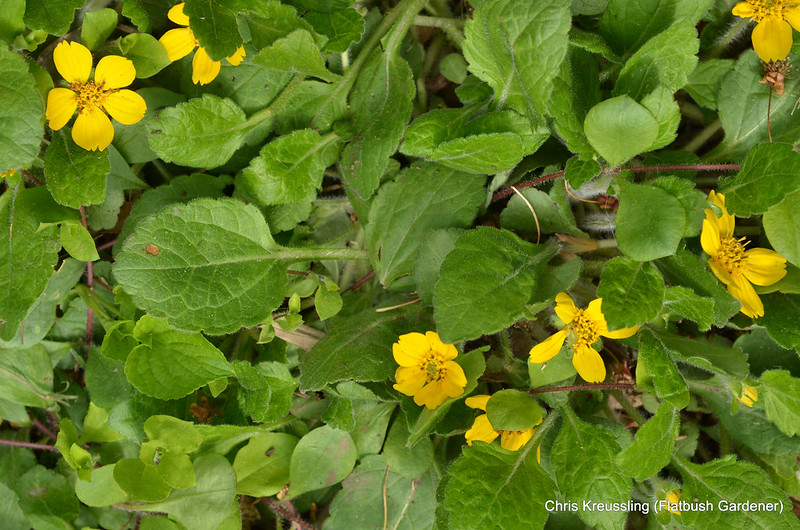
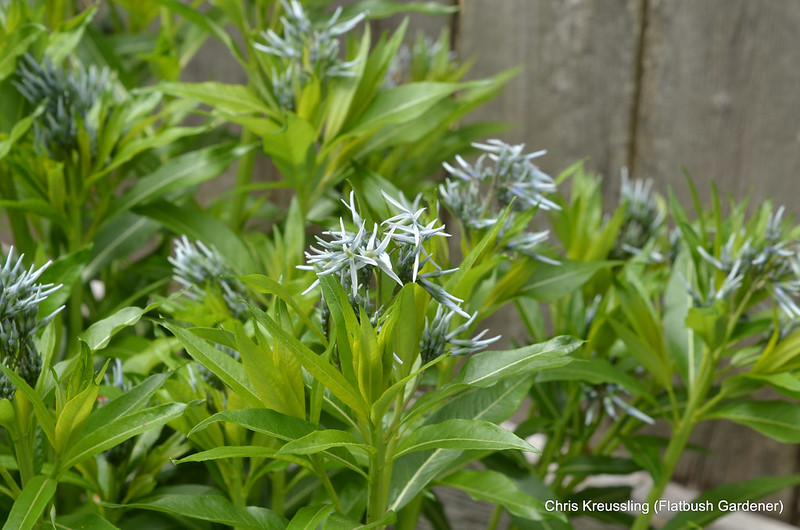
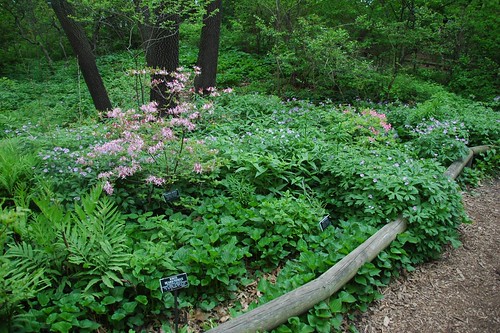
Lonicera sempervirens, Trumpet Honeysuckle, blooming in my urban backyard native plant garden and wildlife habitat this afternoon. My little urban backyard native plant garden is in its peak Spring bloom:
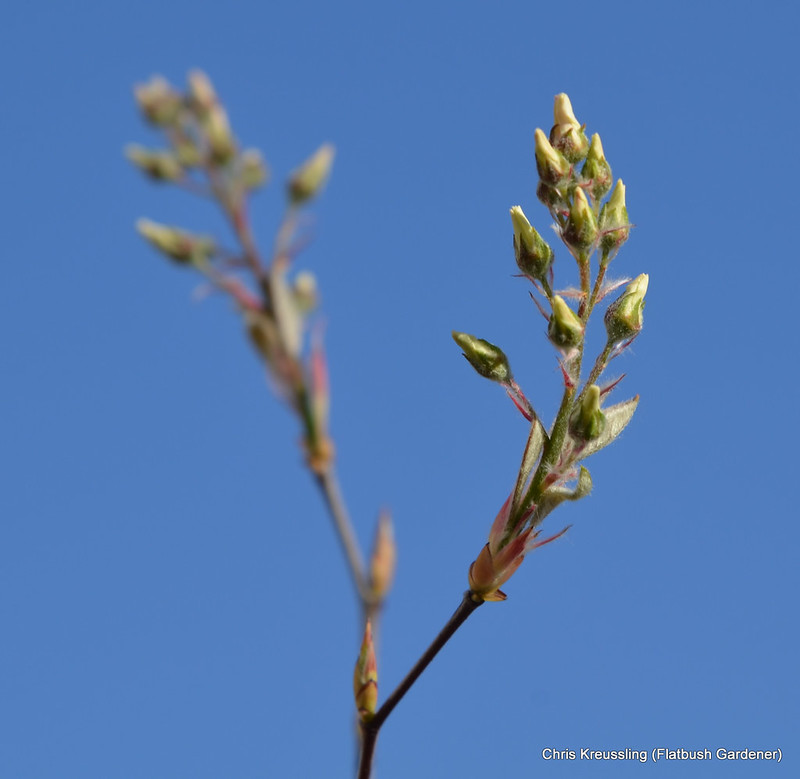
With a score or so species, subspecies, and natural hybrids native to northeastern North America, the genus Amelanchier goes by several common names, many of which represent the plants’ phenology:
It blooms now, when the ground has thawed enough to dig new graves, and services can be held for those who died during the Winter.
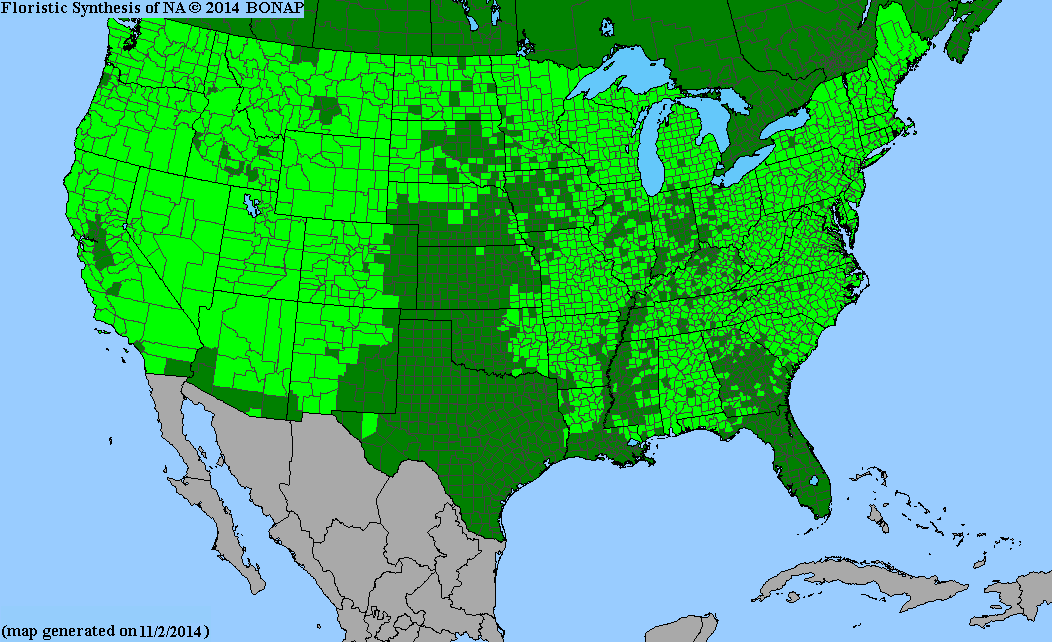
Alosa sapidissima, American Shad, print by Shermon Foote Denton, First Annual Report of the Commissioners of Fisheries, Game, and Forests of the State of New York (1896) County-level map of Amelanchier distribution, Biota of North America Program (BONAP)
There are examples of Amelanchier blooming all around us, if you know what to look for. Unfortunately, you’re more likely to encounter Pyrus calleryana, Callery Pear, alien and invasive, and widely planted as street trees. This year, they started blooming before the Serviceberries.
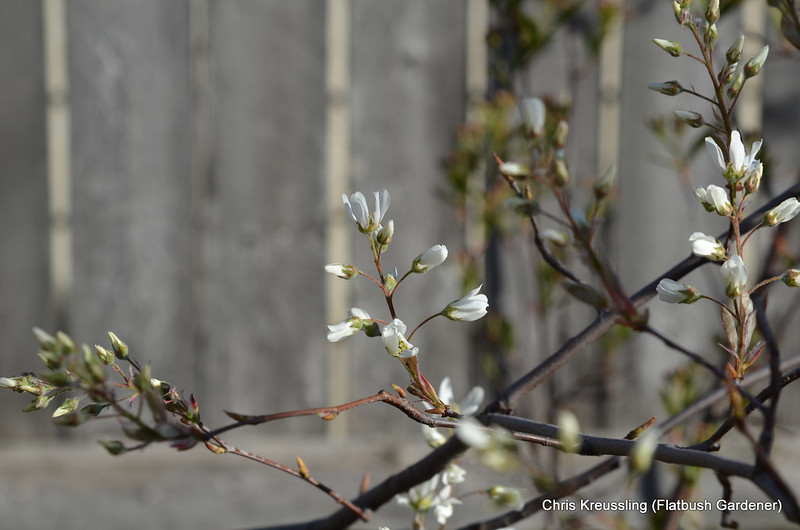
Serviceberries, to my eye, are more elegant, with widely-spaced branches, and feathery flowers held in elongated clusters. My specimen, Amelanchier x grandiflora ‘Autumn Brilliance’, finally bloomed two days ago. It’s opening unevenly, still a day or two away from full bloom. Perhaps it’s as suspicious of our early Spring as I am, hoarding its treasures lest they all be squandered at once to a hard frost.
One of the great pleasures of gardening is observing the activity the garden invites. I can lay out the welcome mat, and set the table, but the guests decide whether or not the invitation is enticing enough to stop by for a drink, a meal, or to raise a family. While charismatic megafauna such as birds and mammals are entertaining, the most common and endlessly diverse visitors are insects.
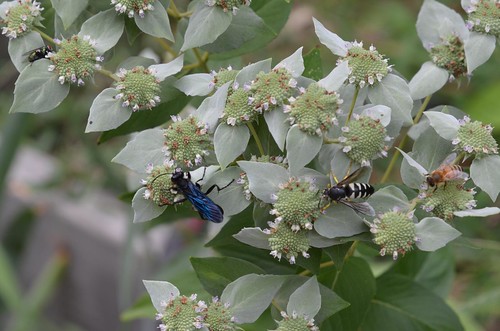
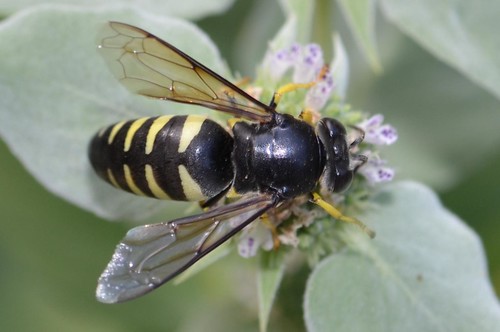
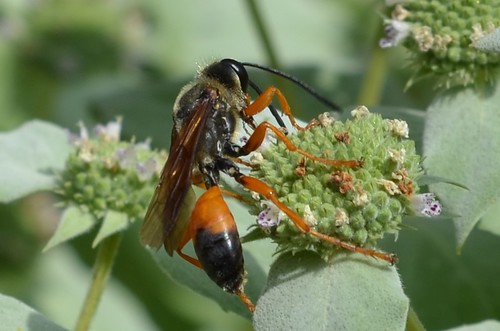
The Hymenoptera includes bees, wasps, and ants. Although my garden also provides amply for ants, we’ll stick with the bees and wasps today. Following are some of the few portaits I’ve been able to capture of the many visitors to my gardens. The pollinator magnet, Pycnanthemum, Mountain-mint, in the Lamiaceae, provides the stage for many of these photos. I’m always amazed at the variety and abundance of insect activity it attracts when blooming.
Multiple pollinators on Pycnanthemum
Bees
There are over 250 species of bees native to New York City alone. I’m still learning to identify just a handful of the dozens of species that frequent my garden.
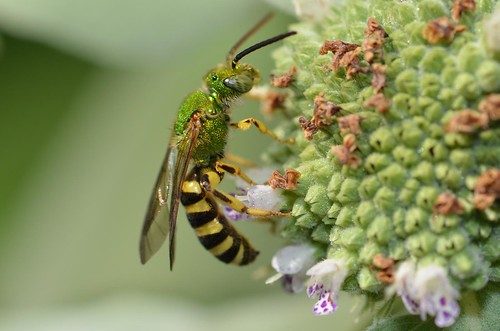
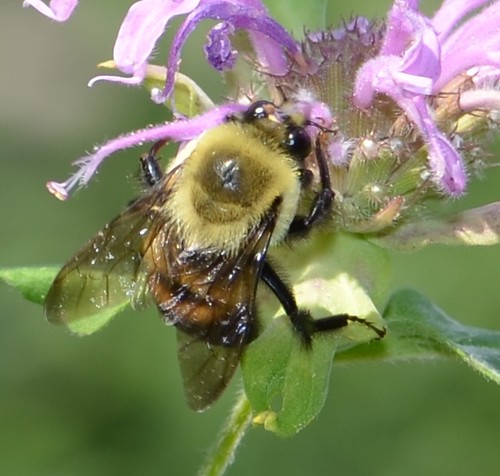
My current favorite is the bejeweled Agapostemon, Jade Bee Bombus impatiens, Common Eastern Bumblebee, on Monarda fistulosa
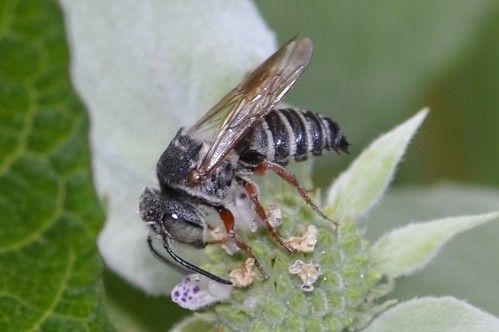
Coelioxys, Cuckoo Bee. I think I’ve got several species from the genus visiting my garden, but I’ve yet to get identification for the others. These are in the Megachilidae, the Leaf-cutter and Mason Bee family. Bees in this family typically carry pollen on hairs beneath their abdomens, instead of in pollen baskets on their legs. You can see this bee isn’t carrying any pollen; it doesn’t even have the hairs beneath its abdomen to do so. It doesn’t need to, because it takes over the pollen-provisioned nests of other leaf-cutter bees for its own young.
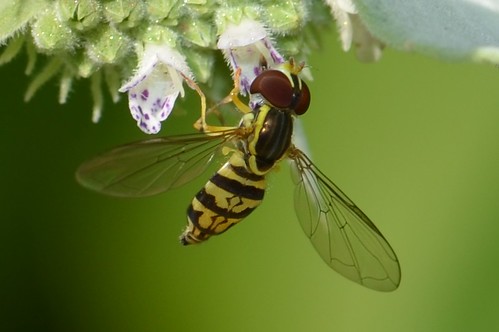
Along with the Hymenoptera come the mimic flies. Many of the seeming bees and wasps, seen from a distance, turn out to be flies on closer inspection. In “the field,” i.e.: my garden, there are two features that provide quick distinction between the two familes:
Antennae: Flies have short, clublike antenna, like feelers, in the center of the face, between the eyes. Bees and wasps have long, segmented antenna arising higher up on the face, almost from the top of the head
Eyes: Flies’ compound eyes are huge, covering nearly all of their face. Bees and wasps have compound eyes that wrap partially along the sides of their heads.
The feet are also different, but I usually don’t notice those until I’m browsing and culling my shots. Finally, bees and wasps have four wings, while flies only have two – Di-ptera, two-winged.
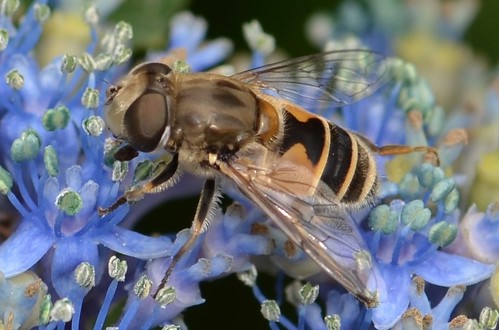
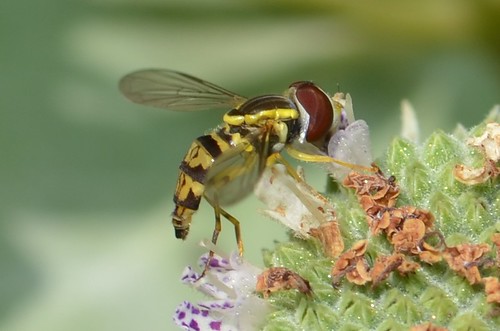
The Syrphidae/Flower-Fly family hosts countless mimics of bees and wasps.
Eristalis arbustorum on Hydrangea
Eristalis transversa, Transverse Flower Fly
Their tactics of mimicry are not limited to patterns and colors. Many species have evolved body modifications to mimic even the shapes of wasps and bees.
Syritta pipiens provides a good example of this. This is the most wasp-like fly I’ve found yet in my garden, though more extreme mimics exist. Glimpsed from behind as it moves quickly over the flowers, it could easily be mistaken for a tiny wasp.
Viewed from the side, or the front, Syritta is more obviously a fly, not a wasp, and a dedicated mimic.
Toxomerus geminatus sports a radically flattened abdomen. This seems to be an adaptation to present a wider area from above, as a predator might view it, for displaying its mimicry, while preserving a smaller volume and keeping weight down.
I wonder what they are mimicing? Might some of these mimics mirror actual target species, not just general “bee-ness” or “wasp-ness”? If so, I would expect to find both the mimic and subject in the same range, and exhibit the same phenology. For example, Toxomerus bears a resemblance to Agapostemon at a quick glance.
Photographing Insect Activity
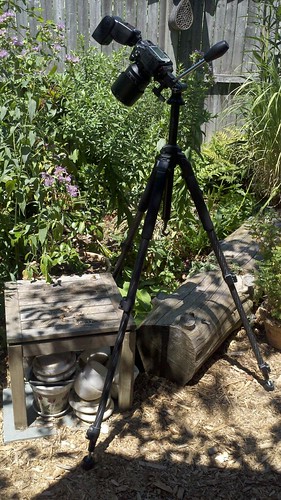
This is my setup for doing live insect macro photography “in the wild,” i.e.: in my garden. The lens is a specialized macro lens that allows for an extremely close focusing distance, though I’m not taking advantage of it in this example. I target some flowers with lots of insect activity, in this case, a local ecotype of Monarda fistulosa, in the Lamiaceae, the Mint Family. Then I wait for insects to visit the flowers, within range of the camera.
I use the tripod handle to pivot up and down; it turns side-to-side easily. Ease of rapid movement with stability is critical, as the insect subjects move rapidly over each inflorescence, and from bloom to bloom. Still, the tripod only steadies my own shaky hands. The insects, of course, are moving, but so are the plants, which sway with the slightest breezes. A fast auto-focus helps; a quick hand is still needed when automation fails.
The mobility allows me to track a single insect as it moves around, and capture different shots, and perspectives, on the same individual. This is critical for identification, since I don’t know until later what the key features to look for might be. It’s often some tiny detail, only revealed from some obscure angle, that distinguishes the species.
My subjects, while largely oblivious to my actions, are not cooperative. I have to shoot hundreds of photos to get a few good shots that are in focus, free of motion blur, and have enough of the right details to identify the species, or at least narrow down to the family. This was never possible, or at least not economically feasible, before digital photography.
Macro shot of Pycnanthemum inflorescences, with common objects for scale: left, pencil eraser, right, U.S. nickle coin.
Eric Grissell, Bees, Wasps, and Ants: The Indispensable Role of Hymenoptera in Gardens
Douglas W. Tallamy, Bringing Nature Home: How You Can Sustain Wildlife with Native Plants
The Xerces Society, Attracting Native Pollinators:Protecting North America’s Bees and Butterflies
Links
The bug geeks at BugGuide are awesome. Only through their generous sharing of knowledge and expertise have I been able to identify my little visitors. They cover the United States and Canada.
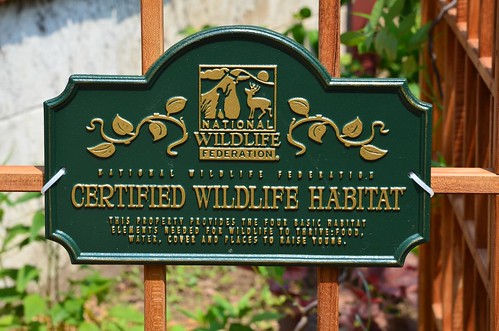
After readying my backyard native plant garden for its debut tour for NYC Wildflower Week in May, I decided to complete the requirements to register my garden as a Certified Wildlife Habitat (#141,173) with the National Wildlife Federation. With over 80 species of native plants, I easily met three of the four requirements: shelter, food, and places to raise young. All I lacked was water, a requirement satisfied by placing some birdbaths and a terra-cotta cistern.
On Friday, May 27, I mounted the plaque on the entrance arbor.
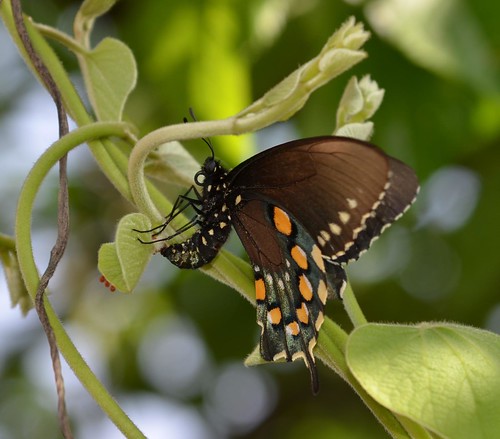
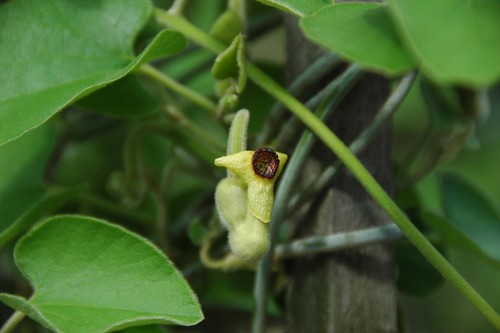
The morning after I put out this welcome mat, I saw butterflies visiting a vine in the garden. I was puzzled, since the plant wasn’t blooming yet. Closer observation revealed that they were laying eggs on the vine. Battus philenor, Pipevine Swallowtail, ovipositing on Aristolochia tomentosa, Wooly Dutchman’s Pipevine
At first, I thought they were Papilo troilus, Spicebush Swallowtail, a species I’ve encountered before. But one of my tweeps, Marielle Anzelone, id’d it as Pipevine Swallowtail, a lifer butterfly for me. Upon researching the species, I was somewhat relieved to learn my confusion has some scientific basis: both the Spicebush and Pipevine Swallowtails, along with several other species, are members of a mimicry complex. As described on BugGuide, “members of this complex present a confusing array of blue-and-black butterflies in the summer months in the eastern United States.” The arc of orange spots on the underside of the hindwind, clearly visible in the photo above, is a key to distinguishing this species from other members of the complex.
The other key was the host plant. Of course, Pipevine Swallowtail would lays its eggs on Pipevine, in this case, Aristolochia tomentosa, Wooly Dutchman’s Pipevine. This plant was a rare find; I’ve never seen it offered again, or elsewhere. A few years ago, I visited Gowanus Nursery – my favored retail source for native plants in Brooklyn, even New York City – and asked if they had any Dutchman’s Pipe. I was hoping for A. macrophylla, a species with huge leaves, and a Victorian gardener’s favorite. They had some Aristolochia, but neither of us could id the species. Adventurous gardener that I am, I took a chance and brought home a quart specimen with a few, thin stems and small leaves. When it eventually bloomed, I was able to id it.
A few years later, the plant is huge, with dense foliage, though the leaves have remained small. It keeps reaching upward several feet, self-supporting its lax stems, and climbing into the cherry tree above it. It serves to screen the composting area from the rest of the garden. I think the mature growth of this plant, rather than the habitat plaque, is what attracted the butterflies to my garden, and select this plant as a host.
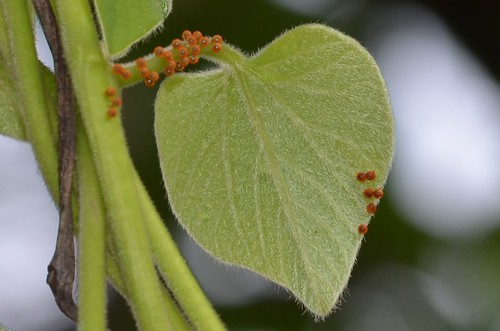
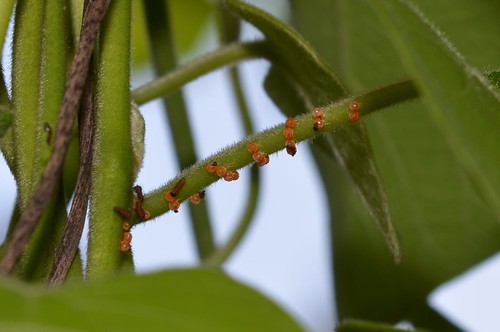
Eggs of Battus philenor, Pipevine Swallowtail on Aristolochia tomentosa, Wooly Dutchman’s Pipevine
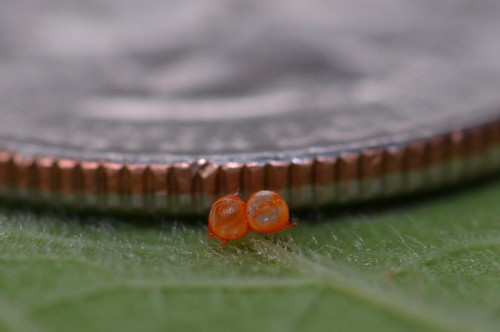
Where I could find them, the eggs were laid only on the young leaves and petioles of fresh growth. This growth is abundant on the mature plant. The eggs are small, especially compared to the depth of the “hairs” of the plant. I suspect laying the eggs on young growth is critical to successful feeding by the young caterpillars. As they get larger, they can manage the larger, coarser hairs and leaves of more mature growth. Empty eggs of Battus philenor, Pipevine Swallowtail, on Aristolochia tomentosa, Wooly Dutchman’s Pipevine. Leaf removed from the vine and U.S. quarter coin provided for scale.
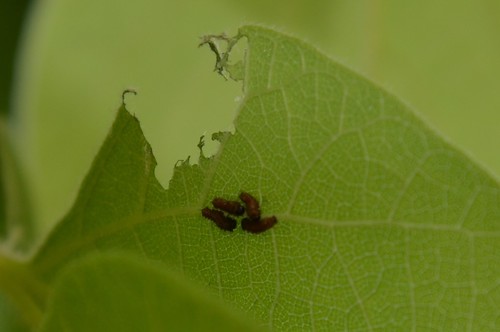
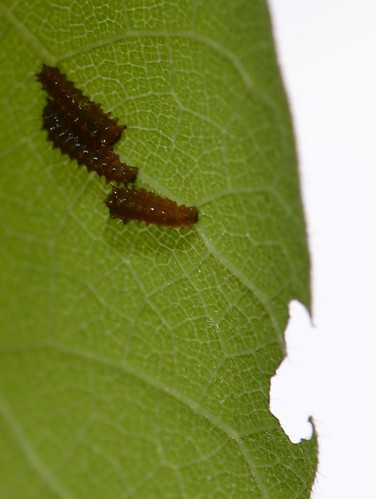
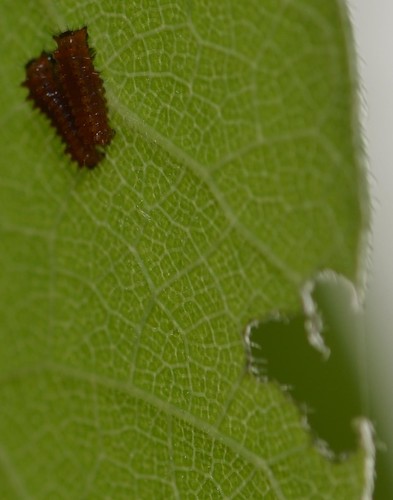
Just five days later, on June 2, the eggs hatched. Newborn caterpillars!
One day after they hatched, I found a group of four little caterpillars on the underside of a different, but nearby, leaf. Two days later, the group was down to three, and three days later, only two caterpillars were left on the leaf. The feeding damage visible in the photos is distinctive: other leaves on the vine have showed signs of feeding, or other uses, but nothing like the fine ragged edges left by tiny little mouths. I haven’t caught them in the act of feeding; I wonder if they feed at night, to avoid detection when active, and remain hidden during the day?
I’ve lost track of the caterpillars now. The vine is dense, with layers of foliage, and many twisting stems. I’ll watch for feeding damage to try to locate and photograph some of them again as they get larger. I’ll also look for chrysalises; catching them emerging as butterflies would be fantastic luck.
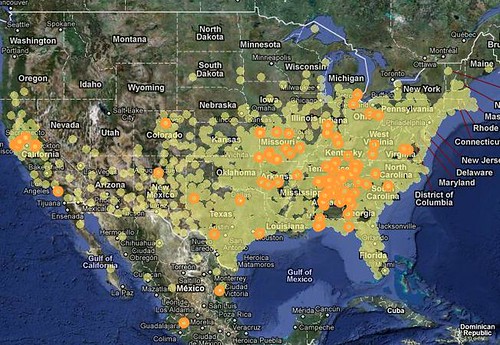
Aristolochia tomentosa is native to eastern and southern North America.
Battus philenor hosts on all species of the genus, so its range covers most of North America.
So, how is any of this “easy to replicate”? While flowers provide food to, and the plants shelter, adult butterflies and moths, a host plant meets three of the four habitat requirements: shelter, food, and a place to raise young. Most native plant species are known to host something. Both Butterflies and Moths of North America (BAMONA) and the international HOSTS Database from the Natural History Museum in London are online resources you can use to discover Lepidoptera-plant host associations.
A single container of a grass or sedge on a balcony can provide habitat. The whole of the cumulative impact of scores, hundreds of such micro-habitats will be greater than the sum. Even in urban settings, we can create opportunities for nature to return and thrive, and by reconnecting with it, we thrive as well.
This Spring has been a season of garden anniversaries for me. Six years ago, my partner and I bought our home in Flatbush. In the first month after closing, I began weeding, composting, and envisioning the gardens. Five years ago, I started this blog to document what I was doing and record my explorations.
It’s also been a season to celebrate the gardens. Last month, for New York City Wildflower Week (NYCWW), I opened my native plant garden for a garden tour for the first time. This Sunday, June 12, the gardens will be opened again, this time for the Victorian Flatbush House Tour, to benefit the Flatbush Development Corporation (FDC). And in May, I registered my garden as a Certified Wildlife Habitat (#141,173) with the National Wildlife Federation.
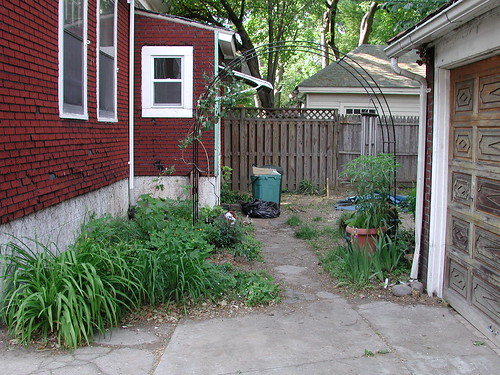
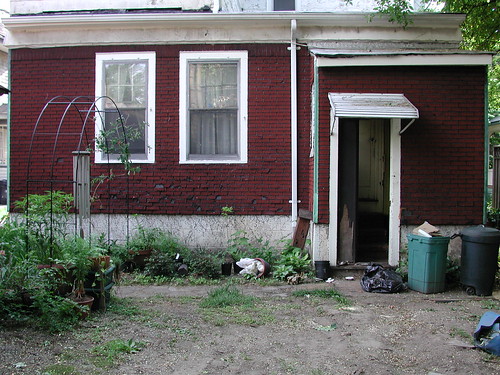
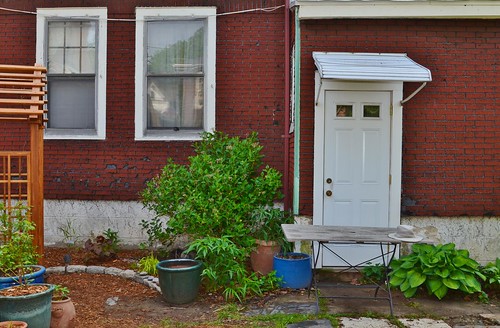
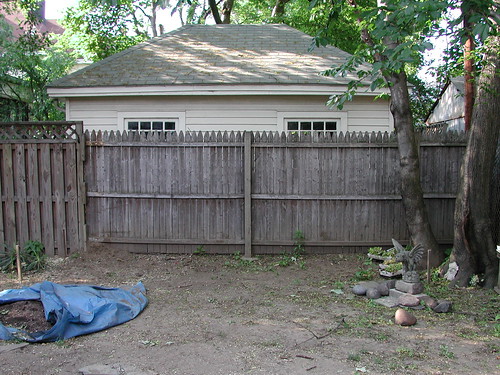
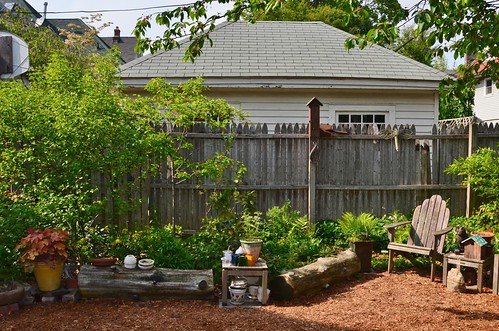
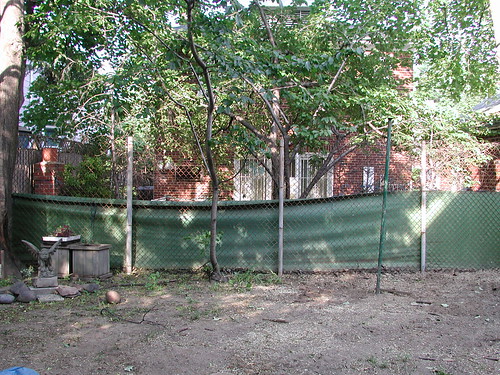
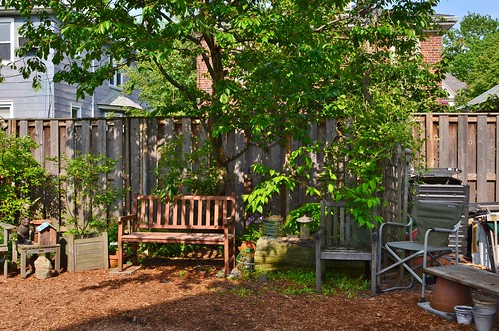
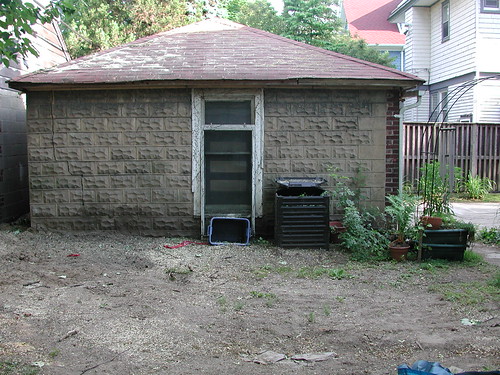
My original vision for the backyard native plant garden is largely realized. I’m close to completing development of the planting beds. The shrubs and perennials have grown and spread; there is little bare ground. Unlike me, the garden looks better than it did six years ago. Take a look, and let me know what you think.
Slideshow
By view of the garden
Entrance from the driveway.
View West, toward the back of the house.
View North, toward our next-door neighbor.
View East, toward our back neighbor.
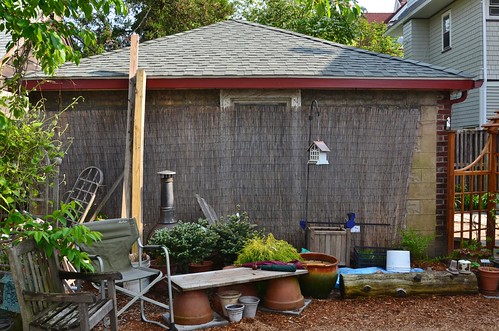
View South, toward our garage. The entrance from the driveway is to the right.
As we approach the Second Annual Great Flatbush Plant Swap, I’m hoping to post some tips on how to divide perennials to bring to the event. Now is the time to do it, as foliage has just emerged, plants are actively growing, and most will recover quickly from any perceived insult of being lifted out of the ground and ripped into pieces.
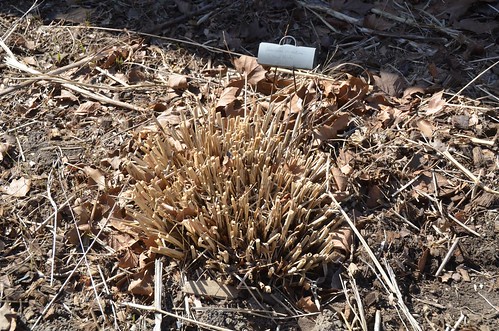
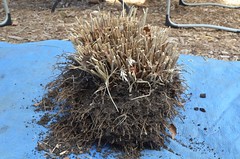
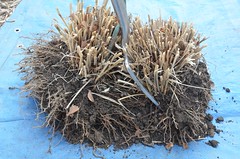
I have to do with this with perennials in my gardens, so I’ll use them as examples. Today I divided one of my larger grasses. This is a three-year old clump of Panicum virgatum ‘Cloud Nine’, a cultivar of our native switchgrass I ordered from Plant Delights in Spring of 2008. Two weeks ago, I cut back all the dead foliage from last year, leaving the stubble you see here. The clump is roughly a foot in diameter. This is ready to be divided.
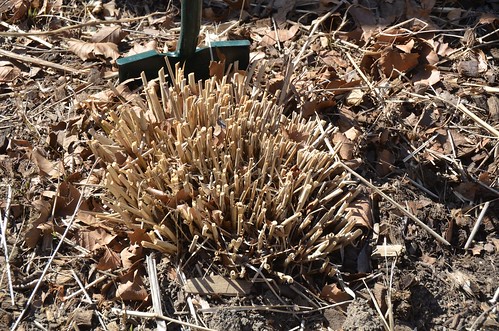
One way to divide is to slice into the plant while it’s still in the ground with a garden spade, taking out slices as if it were a cake. I’ll use that technique on some of my Hemerocallis, Daylilies. Today, I chose to lift the entire clump out of the ground to separate it using two garden forks. This also made it easier to photograph to demonstrate the technique.
Clumping grasses like Panicum often have deep roots, contributing to their general drought-tolerance. To keep enough of the roots, first cut straight down with a deep-bladed garden spade, all around the perimeter of the clump.
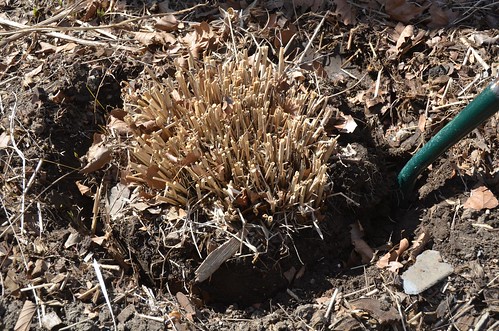
With the perimeter cut, slice beneath the clump to sever the deeper roots. This took a bit of work until I was able to loosen the clump and fork it out of the ground.
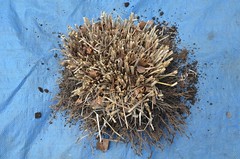
Here’s the intact clump, viewed from the side and from above, set on a tarp for division. Note how deep and dense the roots are, even after severing them with the spade.
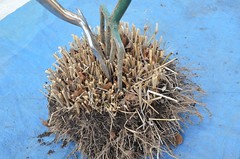
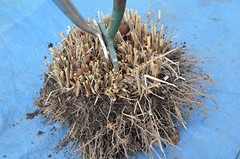
Next take two garden forks. (If you don’t have two forks you could divide the clump with the garden spade at this point.) Place the heads back-to-back, with the handles slightly offset from each other, and drive them down their full length into the center of clump. Note that both heads go straight down, and the handles are splayed out from each other. That provides the leverage you need to separate the clump.
Keeping the tops of the fork heads against each other as a pivot, push the handles toward each other. You’re using the forks as levers to spread and break apart the clump. Push from both sides. If that’s awkward, try standing with one fork toward you, the other away, then push the closer fork away while pulling the further fork toward you. Watch your fingers! When the clump gives, it will release quickly, bringing the handles – and your knuckles – together. Gloves help! Once it gives, simply tease the two halves apart to complete the separation.
It looks like mitosis!
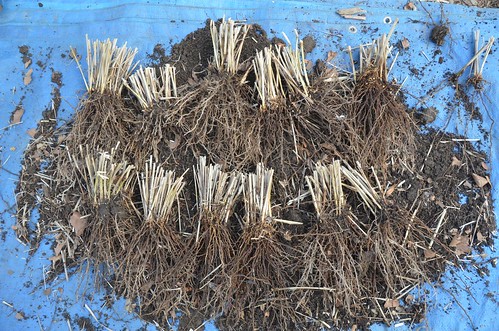
With a large clump like this, I repeated the same process on each of the two halves. I was then able to break apart the four quarters into smaller pieces by hand, giving me a dozen generously sized clumps to replant in my garden and share at the Plant Swap. Some of them will also go to the new native plant gardens for the Flatbush Reform Church communal garden, another project of Sustainable Flatbush.
Brooklyn, NY—June 29, 2010—This spring, the results of a 20-year study of the flora of the New York metropolitan region by Brooklyn Botanic Garden (BBG) found many native species locally extinct or in precipitous decline. During the month of July, BBG will highlight the region’s native flora, displaying its beauty, explaining its importance, drawing attention to its plight, and providing simple ways to help in its restoration. BBG’s knowledgeable horticulturists and scientists will offer a behind-the-scenes look at the power of the native plant through field trips, workshops, and other insightful classes and lectures.
In 1911, the “Local Flora Section” was the first garden to open to the public at BBG. Since then, the Garden has maintained its commitment to the study and conservation of locally native plants, most recently through its multiyear New York Metropolitan Flora project (NYMF), in which nearly every species growing within a 50-mile radius of the city was cataloged and mapped. Many of the native plants in the study—which found a significant number of species in perilous decline—are propagated in the Native Flora Garden, as the Local Flora Section is known today, in an effort to conserve them.
JULY 2010: NATIVE PLANT MONTH PROGRAMMING AT BBG
TALK: Bringing Nature Home Thursday, July 8 | 6:30 p.m.With as many as 33,000 species imperiled in the U.S. alone, it is clear that citizens must change their approach to gardening and landscaping if they hope to share space with other living things. Join ecologist and author Doug Tallamy to learn about the key role native flora must play in the restoration of our landscapes. Only by supporting a large, healthy diversity of insects that coevolved with native plants can we keep herbivores in balance and gardens aesthetically pleasing. Fee required; advance registration is recommended but seats may be available at the door. Call 718-623-7220 or go to bbg.org/classregistration.
CURATOR’S TOUR: The Native Flora Garden with Uli Lorimer Thursday, July 8 | 5–6 p.m.Limited space: register now! Curator Uli Lorimer will lead this tour of BBG’s 99-year-old Native Flora Garden, which represents nine local plant communities, including the distinctive kettle pond and pine barrens habitats. Get behind-the-scenes insight into this extraordinary garden and how it has evolved since 1911. Learn about the visionary work of BBG’s founders in researching and documenting native plant life, both in the Garden and the greater metropolitan area. Fee and registration required; call 718-623-7220 or go to bbg.org/classregistration. Registration deadline: Wednesday, July 7.
FIELD TRIP: Native Plants and Restored Natural Areas: A Field Trip to Staten Island Saturday, July 10 | 8:30 a.m.–2:30 p.m. It turns out that the city’s smallest borough is big on natives! This day trip, led by restorationist Cindy Goulder, begins with a private guided tour of the Greenbelt Native Plant Center, the NYC Parks Department’s 13-acre nursery and greenhouses on Staten Island. See how hundreds of native plant species are propagated and grown from seed and learn principles underlying native plant cultivation. The Sweetbrook Stream and Wetland Restorations help recover the ecological health and function of urban waters, thanks to the indigenous wetland and upland plant species intentionally placed to increase local plant diversity and wildlife habitat. The Salt Marsh Restorations at Old Place Creek have reestablished many acres of tidal marshes after centuries of displacement by agricultural and industrial uses. Learn how invasive plants were removed and zones of marsh and maritime woody plants reintroduced to this estuarine community. Fee and registration required; call 718-623-7220 or go to bbg.org/classregistration. Registration deadline: Wednesday, July 7.
CLASS: Great Natives for Tough Places Sunday, July 11 | 10 a.m.–12:30 p.m.Discover how to turn tough urban spaces into a natural haven! This workshop, led by garden designer Joan McDonald and based on the BBG handbook Great Natives for Tough Places, identifies gardening challenges caused by city buildings, impermeable surfaces, rainwater runoff, construction, and other disturbances that compact and degrade soil. Students will explore solutions with five spectacular designs using unusual native plants chosen for their ability to thrive in urban environments. Students will receive a copy of Great Natives for Tough Places. Fee and registration required; call 718-623-7220 or go to bbg.org/classregistration. Registration deadline: Thursday, July 8.
WORKSHOP: Gardening with Native Plants Tuesday, July 13 | 6–9 p.m. Why are native plants important, and which ones are best for a garden? What does “native” really mean, anyway? Explore these questions with native plant authority Uli Lorimer, curator of BBG’s Native Flora Garden and learn how a garden can reflect the region’s—even a densely populated urban region’s—spectacular natural environment. Fee and registration required; call 718-623-7220 or go to bbg.org/classregistration. Registration deadline: Monday, July 12.
CLASS: Edible Native Plants in Brooklyn Saturday, July 18 | 2–5 p.m.Limited space: register now! Wild ginger, spicebush, fiddlehead ferns, wild leeks—these are just a few of the delicious vegetables and seasonings native to the region. Unlike conventional crops, many of the northeastern edible native plants are excellent for shade gardens, and most are perennials that will feed people year after year. Learn from local food specialist Leda Meredith which edible native plants will thrive in a garden and how to grow, harvest, and use them. Fee and registration required; call 718-623-7220 or go to bbg.org/classregistration. Registration deadline: Thursday, July 15.
Contact: Kate Blumm, Brooklyn Botanic Garden 718-623-7241 | kblumm@bbg.org
Prunus maritima, Beach Plum, blooming this past April in the Pine barrens section of BBG’s Native Flora Garden
Today I planted Amelanchier x grandiflora ‘Autumn Brilliance’, Apple Serviceberry, in my backyard native plant garden.
I chose my backyard as my final class project for Urban Garden Design at the Brooklyn Botanic Garden last year. Serviceberry is one of the two key plants I specified for my planting scheme. Serviceberries are multi-season plants. They bloom in early Spring, before the flowering cherries. The berries ripen in mid-summer; they are edible and tasty, and attractive to birds. Fall color is excellent. Branching structure and bark provide winter interest.
Here are the initial sketch and final design for the project. The Amelanchier is the second smallest circle on the left (north) of the plan. In this design for an urban woodland garden, the Serviceberry plays the role of an understory tree. The larger circle on the right is Sassafras albidum, the canopy tree, which is proving even more difficult to source than the Amelanchier.
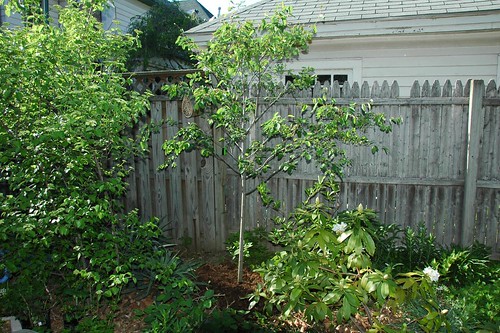
Here’s how the north bed looked this afternoon, before planting the tree. The large shrub is Viburnum dentatum ‘Blue Muffin’, Arrowwood, which I transplanted here last Spring.
The Serviceberries hybridize readily in the wild. Although I specified A. arborea, A. canadensis, or A. laevis in my plant list, the species have proven difficult to locate. A. x grandiflora is a horticultural hybrid of my preferred species – sources disagree on whether it’s between A. arborea or A. canadensis and A. laevis – so this is a good alternative. Serviceberries are in the Rosaceae, the Rose Family, and so are subject to the same diseases as more conventional fruit trees such as apples. ‘Autumn Brilliance’ is a cultivar selected for its fall foliage and disease resistance.
Serviceberries sucker readily. Their growth is usually shrubby. even the larger species typically grow as trees with multiple trunks, but they can be trained to a single trunk. I went looking for such specimens on Thursday. I found two at Chelsea Garden Center in Red Hook. One was already tagged as sold. I bought this one.
It’s deceptively small-looking in the photo. That’s a 15-gallon container. Once I got it into the backyard, I had some appreciation for the task I’d set for myself. Here it is set on the wagon I used to wheel it into the backyard.
How to plant a tree
When planting a tree, it’s important not to plant it deeper than it was grown. I measured the depth of the container, and used that as a guide; since the soil level in the container is two inches down from the edge, I took two inches off the height of the container. You can also just take marks against your planting tools. I made final adjustments of depth with the tree in the hole: starting high, then gently tipping the tree and taking out just one shovelful at a time until the top of the roots were just above their original depth.
I also measured the width of the container. Normally, the width is not important: you can dig two or three times wider than the width of the roots, the wider the better. But I was planting into tight quarters – an already planted bed – and didn’t want to have to remove more soil than I needed to. Also, I worked this soil last Spring, when I built out the bed, so I didn’t need to dig a wider hole this time around.
Before I tucked the tree in, I took the opportunity to prune out any broken or crossing branches. It doesn’t affect the look of the tree, and reduces later problems. This is easier to do with the tree on its side than upright. I have a pole pruner to use as the tree gets bigger.
Before
After. See? It doesn’t look any different.
The final challenge: getting the tree to and into the hole without destroying the other plantings. For this, I setup a wide board as a ramp to slide the root ball over the other plants.
Fortunately, just at this moment, Blog Widow returned home, and a neighbor stopped by. We made quick work of getting the tree in, with little damage to the other plants.
Mature size is 15-25′ high and wide. This will provide critical late day shade for the wildflowers and ferns planted in this bed. I could already see the difference today. Birds will be attracted to the fruit, which ripen before those of the existing Viburnum and Ilex verticillata. With early bloom and excellent fall color, this tree will anchor the garden in all seasons, and help define the space. This is the single most costly plant I’ve ever purchased. It’s one of the best investments I’ve made in the garden.
Ten Parks recreation centers, including three in Brooklyn, will be getting green roofs. The planting will be based on two regional plant communities:
Each system will include 12 experimental plots, 85 square feet each, with soil depths ranging from 4 to 6 inches.
Each plot will be planted with a species mix from two native plant communities, the Hempstead Plains (Long Island) and Rocky Summit Grasslands (e.g. Bear Mountain) of the New York City region. These models were chosen because they are meadows, have plants that can tolerate the desiccated soils and high winds typical of roof conditions, and provide prime foraging for native insects and birds.
Here are the species they’ve specified from each community:
Hempstead Plains:
Schizachyrium scoparium, Little bluestem (Grass)
Panicum virgatum, Switchgrass
Sorghastrum nutans, Indian grass
Baptisia tinctoria, Yellow wild indigo
Solidago nemoralis, Gray goldenrod
Asclepias tuberosa, Butterfly-weed
Eupatorium hyssopifolium, Hyssop-leaved boneset
Rubus flagellaris, North Dewberry
Rocky Summit Grasslands:
Carex pensylvanica, Pennsylavania sedge
Danthonia spicata, Poverty-oat grass
Deschampsia flexuosa, Common Hairgras
Lespedeza capitata, Bush-clover
Lysimachia quadrifolia, Whorled loosestrife
Cunila origanoides, Stone-mint, Dittany
Solidago odora, Licorice-goldenrod
Vaccinium angustifolium, Low-bush blueberry
Cunila origanoides is one of the three native plant species that were given away at the kickoff for NYC Wildflower Week last Saturday in Union Square. It’s in the Lamiaceae, the Mint Family. Its leaves smell like oregano. (The other two species were Thalictrum pubescens and Hystrix patula.) I would expect that these plants have been propagated at the Greenbelt Native Plant Center. I’m trying to confirm that.
The Native Flora Garden at the Brooklyn Botanic Garden, May 2009. This was the first garden constructed after BBG was established on the site of a municipal ash dump 100 years ago, and the first public garden devoted to native plants. Next Wednesday’s tour of this garden with Uli Lorimer, curator of BBG’s Native Flora Garden and an instructor in their Certificate in Horticulture program, is one of over 45 FREE events in all – available during NYC Wildflower Week.
NYC Wildflower Week kicks off Saturday 5/1. This is the third year for the event, and it’s bigger and better than ever. There are events all over the city, including tours of locations otherwise closed to the public. I’m looking forward to visiting, for the first time, the Greenbelt Native Plant Center on Staten Island, “the only municipal native plant nursery in the country.”
From Friday, May 1, to Saturday, May 9, we’re celebrating the hundreds of native flowers, trees, shrubs and grasses in the Big Apple. Take advantage of the spring weather, and come out for a week of environmental learning, with free activities, walks, and talks galore.
I’m proud that this year, for the first time, I’ve been invited to participate in an official capacity. This Saturday morning, May 1, I’ll be on-hand at the information booth at Union Square to help answer questions and provide information about native plants. A male Agapostemon, Green Metallic Bee, on a native perennial Helianthus, Sunflower, in my backyard native plant garden. Native plants provide vital habitat – food, forage, and shelter – for this and the rest of the more than 250 of bees native to NYC.
What can you do to help preserve NYC’s native plants?
Take a walk. Head outdoors with a field guide and a friend to learn about the botanical jewels in your neck of the woods. Preservation comes to those places that are loved by people.
Ride with the masses. Whenever possible, take mass transit. Let your legislators know how you travel. New roadways promote sprawl and destroy and degrade habitat. If this money were instead used to bolster mass transit, we could conserve oil, preserve biodiversity and decrease sprawl.
No picking. Removing native plants from the wild depletes natural populations. Never take plants from parks or other open spaces. An exemption – if a site were slated for development, then the plants should be rescued and moved to another site, but ONLY if you were absolutely certain that the plants would otherwise be destroyed.
Be civically active. Development is the #1 cause of native plant destruction. Make note of open space slated for a strip mall or housing complex or active recreation area (because even settings like ball fields and golf courses eat up natural habitats). Attend community board meetings. Voice your dissent. Open space allows for passive recreation, like plant hunting, birding and hiking. Such activities nurture the naturalist in all of us.
Preserve open space. Work to save our natural areas. Become a member of a local land trust or conservancy devoted to preserving open space and natural resources. If one doesn’t exist, consider starting your own.
Join a botanical society. New York, New Jersey, Pennsylvania and Connecticut all have native plant societies. These groups lead tours through local fields and forests and always welcome new plant people. See our Resources page to learn more.
Compost with care. Most homeowners believe it is environmentally responsible to pile lawn refuse (grass clippings, leaves, twigs) in adjacent open areas. Don’t. By dumping garden waste in woods or at property edge, you may be inadvertently overwhelming critical habitat for plants and animals!
Lay off the herbicide. Is it really that important to have a “weed free” yard? The struggle for pristine green carpet (aka lawn) is a struggle against nature itself. Herbicides kill the native plants on and around your property. Instead, keep turf to a minimum, and maximize color, richness and beauty with native plant gardens.
Legal protection for plants. New Jersey, New York, Pennsylvania and Connecticut all have something in common – none of these states have laws safeguarding native flora. Moreover, they have no legal protections for rare plants. An undeveloped lot chuck-full of uncommon and unique vegetation is not legally viewed as special. This site is just as likely to be built upon as a lot full of crummy weeds. This happens even at the Federal level, where most of the money from the Endangered Species Act goes towards animal protection. Let your legislators know that your flora should have rights. Flower power!